






1、 Concept and classification of inferior debt
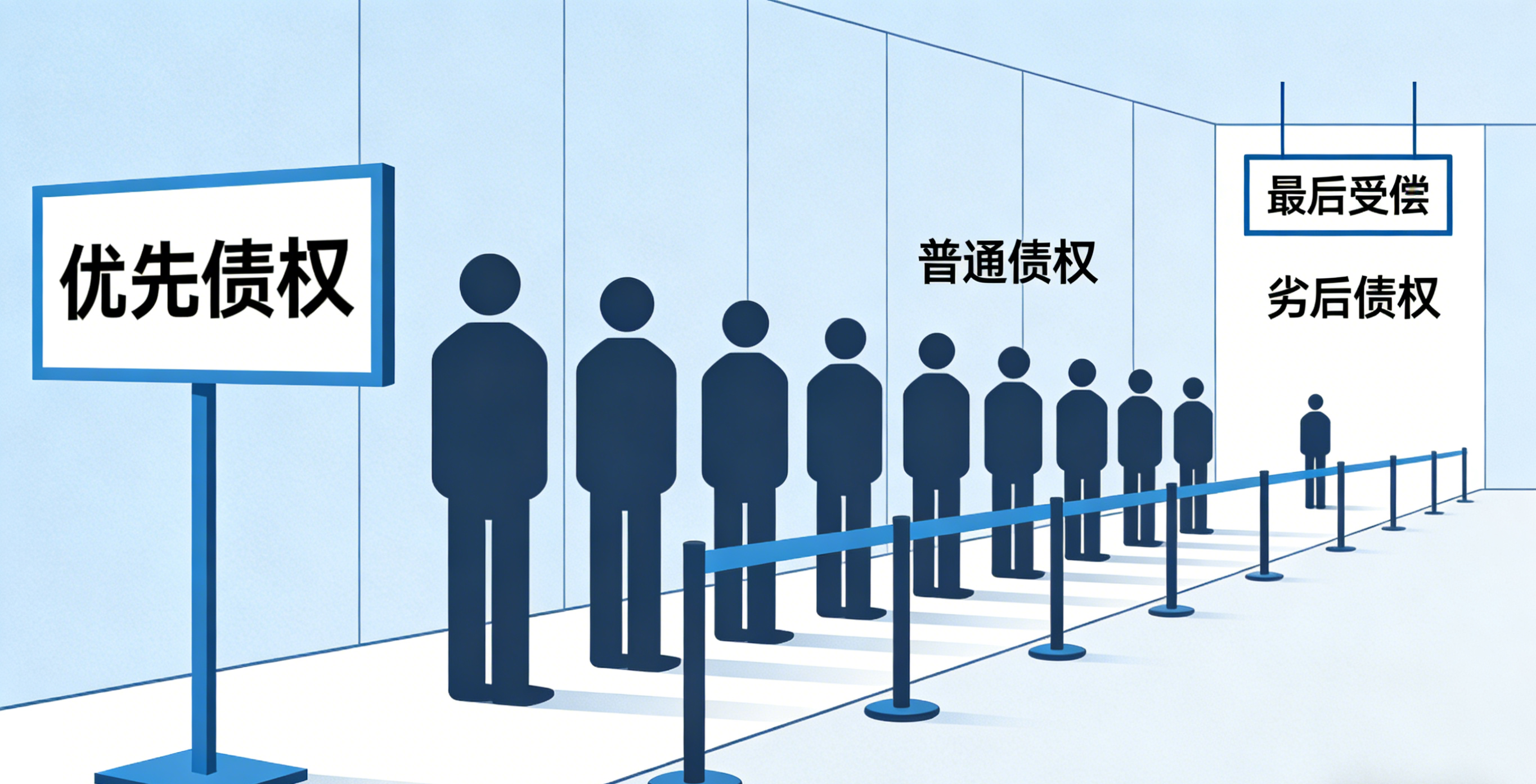
Subordinate debt refers to debt that is inferior to ordinary debt in terms of bankruptcy liquidation order. According to different causes, subordinated debts can be divided into three basic types: statutory mandatory subordinated debts, agreed subordinated debts, and judge ruled subordinated debts.
① Statutory mandatory inferior debt
Statutory mandatory subordinated debt refers to the debt that is determined to be subordinated to other ordinary debts after being determined by bankruptcy laws and regulations, mainly including the following types of debt:
-
Interest on bankruptcy claims;
The cost of creditors participating in bankruptcy proceedings;
Fines imposed by the government or judicial authorities.
② Agreed inferior debt
Contracted inferior debt refers to the debt that is agreed upon in advance based on the autonomy of the parties, and is subject to inferior repayment in the event of bankruptcy. As long as the agreement does not violate mandatory legal provisions, the bankruptcy law respects the autonomy of the parties and recognizes their subordinate status.
③ Judge's ruling on inferior debt
The judge's ruling on inferior debt refers to the debt that the judge is authorized by law to award as inferior debt, generally including the following two types:
-
Claims against the bankrupt arising from improper transactions by controlling shareholders, actual controllers of the company, and other individuals.
Senior management personnel such as directors, supervisors, and managers of bankrupt companies, as well as "insiders" such as spouses of bankrupt individuals and partners of partnership enterprises, have creditors' rights.
2、 Identification and Analysis of Bankrupt Shareholders' Subordinate Debt Rights
Although the current bankruptcy law and its judicial interpretations in China do not provide clear provisions for inferior debts, only stipulating "priority debts" and "ordinary debts". However, on March 4, 2018, the Supreme People's Court issued the "Minutes of the National Court Bankruptcy Trial Work Conference", which stipulated in Article 28 that "punitive claims" should be paid in a lower order than ordinary claims; Meanwhile, Article 39 clearly stipulates that the creditor's rights formed by improper use of related relationships among members of affiliated enterprises shall be repaid in a lower order than other ordinary creditors' rights. The content of the above meeting minutes has actually become the relevant basis and support for judges to rule on inferior debts in judicial practice.
In judicial practice, it is common for shareholders or actual controllers to take advantage of their control of the company to engage in unfair behavior based on their internal advantage when their own creditors conflict with those of general creditors, thereby harming the interests of other creditors. To address this issue, many judges, based on the principle of fairness, classify the creditors' rights against the company due to improper behavior committed by shareholders using their advantageous position as a type of subordinate debt in specific case judgments.
The discretion of judges cannot be exercised arbitrarily, and not all shareholder claims should be included as subordinate claims in bankruptcy proceedings. According to Article 4 of the "Reply of the Chongqing High People's Court on Legal Issues Concerning the Trial of Bankruptcy Cases" (Yu Hui Bao [2017] No. 207), in bankruptcy proceedings, if any of the following circumstances occur, the creditor's rights of the company's shareholders or actual controllers against the company can be determined as subordinate creditor's rights and arranged to be compensated after ordinary creditor's rights:
-
Shareholders of the company owe debts to the company due to failure to fulfill or fully fulfill their capital contribution obligations or withdraw their capital, and their debts fall within the scope of the unfulfilled or partially fulfilled capital contribution obligations or withdrawal of capital;
The registered capital of the company is clearly insufficient to support the normal operation of the company, and the company's operation relies on raising debts from shareholders or actual controllers, resulting in the formation of creditor's rights against the company by shareholders or actual controllers;
The creditor's rights arising from unfair transactions between the controlling shareholder or actual controller of the company and the company for their own interests.
The creditor's rights formed by the shareholders or actual controllers of the company in the aforementioned circumstances shall not be exercised with the right of exclusion or offset.
Conclusion
In summary, in order to maximize the procedural protection of creditors' interests, the bankruptcy administrator will focus on whether the claims declared by the controlling shareholder and its affiliates fall under the circumstances stipulated in the "Chongqing High People's Court's Answers to Legal Issues Concerning the Trial of Bankruptcy Cases" during the process of debt review and recognition. If shareholders do engage in improper behavior, the manager should use the above rules to confirm the shareholder's declared debt as a subordinate debt.
-
- Brief Analysis of the Key Points of the Company's Liquidation Responsibilities (2) - Shareholder Responsibility
The liability of shareholders in liquidation is mainly stipulated in Articles 18, 19 and 20 of Interpretation II of the Company Law, namely "non-liquidation and cancellation", "delayed liquidation" and "illegal liquidation".182023-02 -
- Brief Analysis of the Key Points of the Company's Liquidation Responsibilities (1) - The Responsibility of the Liquidation Team
As an important subject of the current business society, one of the important characteristics of the company is that its shareholders are liable to the company up to the amount of subscribed capital contribution. However, in practice, it is precisely because of this understanding that the relevant entities (liquidation obligors) do not pay enough attention to the statutory procedures for the liquidation and cancellation of the company after the reason for dissolution arises.172023-02