






As an important subject of the current business society, one of the important characteristics of the company is that its shareholders are liable to the company up to the amount of subscribed capital contribution. However, in practice, it is precisely because of this understanding that the relevant entities (liquidation obligors) do not pay enough attention to the statutory procedures for the liquidation and cancellation of the company after the reason for dissolution arises. Even if the liquidation is carried out in accordance with the law, due to the lack of professional knowledge and experience, it fails to fully perform the liquidation procedures in accordance with the law, resulting in the relevant entities (involving shareholders, liquidation teams, members of the liquidation team, most of whom are company executives) still being held legally responsible after the company is deregistered.
This paper takes the common liquidation liabilities involved in limited liability companies as the argument and briefly analyzes the specific application situations in combination with cases to remind the practical points involved in the liquidation of limited liability companies.
However, the liquidation team itself has no property, so in practice, the liquidation team is based on the theory of joint infringement, which is reflected in the fact that the members of the liquidation team are liable first, and the members who bear the responsibility for damages can be held accountable according to the division of labor within the liquidation team. Specifically, there are the following situations:
1. The liquidation team failed to perform its notification and announcement obligations, resulting in the creditors not being repaid
【Legal basis】
Article 11, Paragraph 2 of the Company Law Interpretation II:
If the liquidation team fails to perform its notification and announcement obligations in accordance with the provisions of the preceding paragraph, resulting in the creditor failing to declare its claims in a timely manner and is not repaid, and the creditor claims that the members of the liquidation team are liable for the losses caused thereby, the people's court shall support it in accordance with law.
【Practical Points】
1. Difference between notice and announcement
Notice and announcement are not either-or-obligatory statutory obligations, and their applicable objects are different:
-
Notice: For known creditors -
Announcement: For unknown creditors
Both are indispensable. Regarding the number of announcements, the 2005 amendment to the Company Law has removed the requirement of three announcements, and it is sufficient to make an announcement once in the national or provincial newspapers where the company is registered according to the size and business geographical scope of the company.
2. Criteria for determining known creditors
Regarding the definition of a known creditor, that is, the claim is not recorded in the company's financial books, but the creditor has claimed the corresponding claim against the company, should the notification obligation be fulfilled? There are three main situations:
| situation | Identification | Treatment Recommendations |
|---|---|---|
| (1) Claims that have been confirmed by the effective judgment or arbitral award of the court | The controversy is not great | should be notified |
| (2) Although there is no effective judgment or arbitral award confirmation, there is relevant information that can relatively determine the existence of creditor's rights | The controversy is not great | should be notified |
| (3) There is relevant information, but there is a large dispute over whether the creditor's rights are disputed (also known as "uncertain claims" or "suspense claims") | Judicial practice is divided | Recommended Notices |
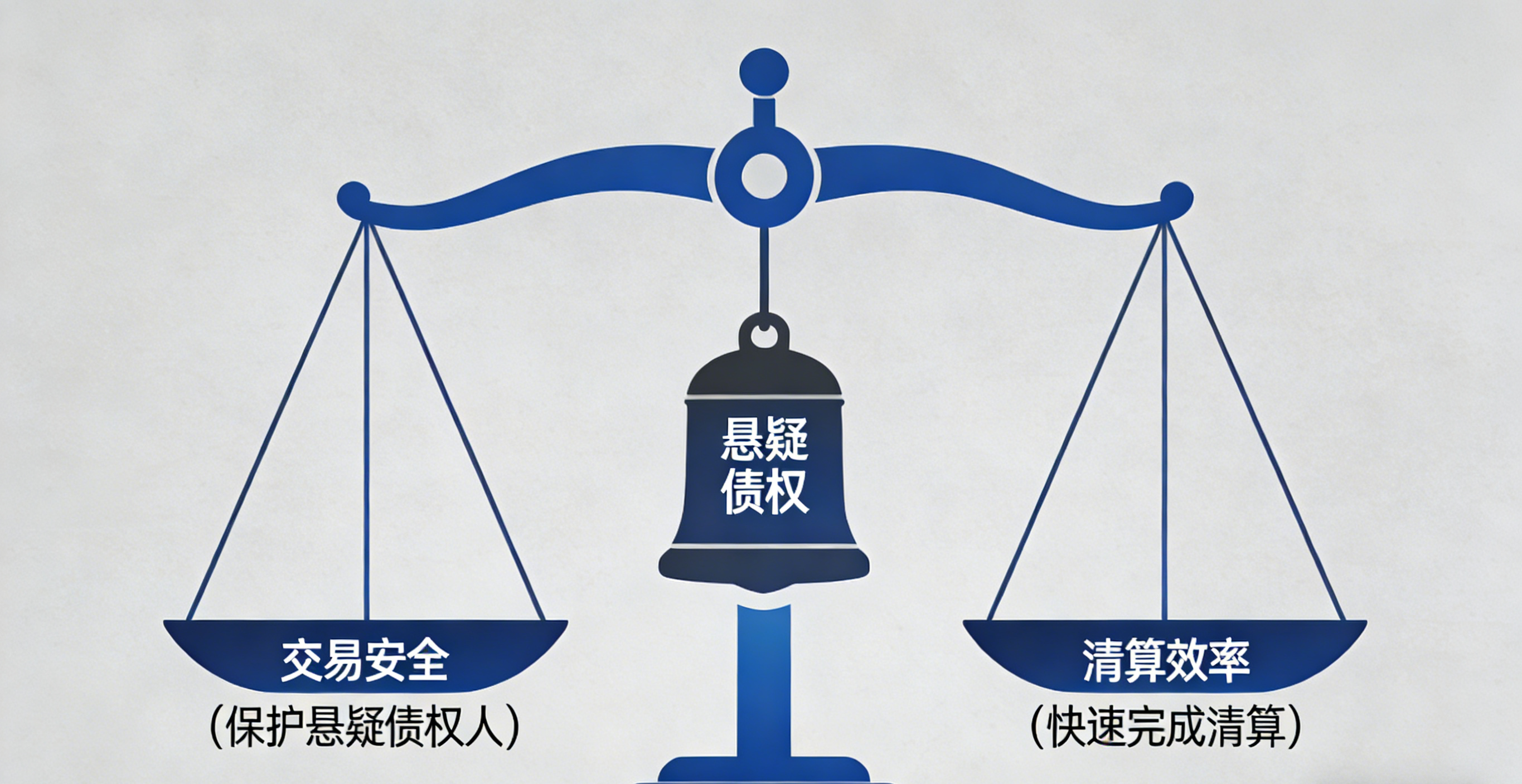
For (1) and (2), there is little controversy. However, for the case (3) suspense claims, they are often intentionally or unintentionally excluded or ignored in liquidation, and their disposal often falls into a dilemma, which is actually a matter of legal trade-off between the two values of transaction security and efficiency. There are different views in judicial practice.
Case comparison:
-
(2016) Jing 0106 Min Chu No. 3295: The court held that protecting the interests of the company's creditors should include protecting the interests of suspense creditors, but the primary condition for suspense creditors to be included in the scope of liquidation is declaration, otherwise it should be excluded from the scope of liquidation, and the plaintiff's claim was not supported. (However, the case was later revoked by the Beijing Second Intermediate People's Court).
-
(2021) Lu 09 Min Zhong No. 98: The Tai'an Intermediate People's Court held that although the case involving suspense creditors is still in the process of being tried, the liquidation team should still notify the suspense creditors to declare their claims.
In view of the judicial practice that focuses more on protecting the interests of creditors, we suggest that even suspense claims should be included in the scope of creditors' notices, so as to prevent members of the liquidation team from being held accountable after the company is deregistered.
3. Responsible entity - shareholder or liquidation team member?
When there is a dispute between shareholders and members of the liquidation team, the responsible entity does not need to discuss. However, in practice, the company will entrust the company's directors, senior executives, legal representatives and other natural persons to serve as members of the liquidation team, and in this case, it is controversial whether the court determines the liquidation responsibility by the shareholders or the individual members of the liquidation team.
Comparison of different perspectives:
| Case | Views | Reasons for the trial |
|---|---|---|
| (2021) New 01 Min Zhong No. 1182 (Second Instance) | Not responsible | Li Hui is not a shareholder of the company, but an employee of the company entrusted to participate in the liquidation affairs, and his behavior is an act of duty and should not be liable for compensation |
| (2020) Yue 01 Min Zhong No. 22616 | undertake | Zhou Xinwen is engaged in financial work, and he should be aware of the relevant procedures for the legal cancellation of the company, and as a member of the liquidation team, he should be jointly and severally liable for the repayment of the company's debts |
| (2020) Ji 06 Min Zhong No. 5067 | undertake | As a member of the liquidation team, Ma Shuangyin failed to fulfill his notification obligation to creditors and should be liable for compensation |
It has been widely proven in practice that non-shareholders can participate in liquidation as members of the liquidation team, and the key is whether the liquidation team member is also an employee of the shareholder or an employee of the liquidation company, whether he is exempt from liability based on his or her duties.
The view that it is possible to be exempt from liability is not without a theoretical basis. Article 1191 of the Civil Code stipulates that if a staff member of an employer causes damage to others due to the performance of work tasks, the employer shall bear tort liability. This liability is vicarious liability, that is, the non-tortfeasor is liable for the tort of the actor.
However, judging from the above cases and the search results of other cases, this view has not yet been widely advocated and applied in judicial practice. Moreover, when the members of the liquidation team are only employees of the liquidation company and are not shareholder employees, after the company is deregistered, there is no entity to bear the subscenic responsibility for them, and their liquidation responsibility has nowhere to escape, which is also confirmed in the above-mentioned (2020) Yue 01 Min Zhong No. 22616 case.
2. The liquidation team implements an unconfirmed liquidation plan that causes losses to creditors
【Legal basis】
Article 15, Paragraph 2 of the Company Law Interpretation II:
If the implementation of an unconfirmed liquidation plan causes losses to the company or creditors, and the company, shareholders, directors, other stakeholders of the company or creditors claim that the members of the liquidation team are liable for compensation, the people's court shall support it in accordance with law.
【Practical Tips】
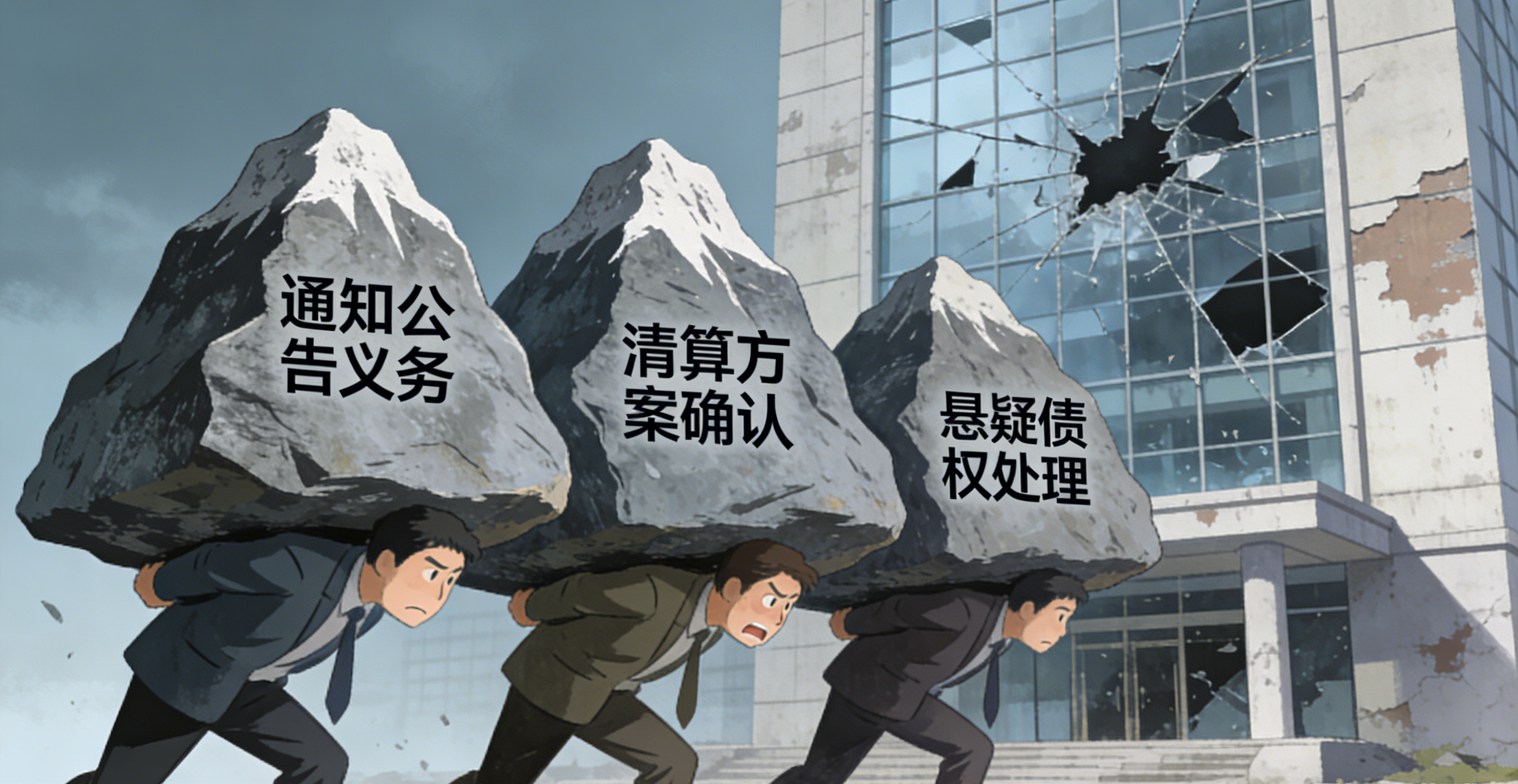
In practice, it is rare to bear the liability for liquidation compensation due to the implementation of an unconfirmed liquidation plan, and since the liquidation plan has been formulated, it is generally submitted to the shareholders' meeting for approval. The problem that is easy to arise in practice is that there is no liquidation plan at all.
Case guidance
In the case of (2021) Lu 02 Min Zhong No. 115:
-
There is no liquidation plan in the industrial and commercial registration materials of Xinhui Company -
There are also no minutes of the shareholders' meeting to confirm the liquidation plan
Therefore, the court held that Xinhui Company violated the law by deregistering the company without formulating a liquidation plan, and its liquidation team members should bear the responsibility for repayment to creditors.
This is not an isolated case, the author has encountered a similar situation in practice, due to lack of experience, the company's personnel pay attention to the results, ignore the process, and only confirm various affairs through the resolution of the liquidation team and the resolution of the board of directors item by item, but do not prepare the liquidation plan.
Summary: The importance of the liquidation plan
Liquidation plays a role in the whole liquidation process, and is a set of plans formulated by the liquidation team in accordance with the law on how to pay off the company's debts and distribute the company's remaining assets after checking the company's assets and confirming the company's creditor's rights.
In addition, regarding the voting procedures of the shareholders' meeting, since this matter is not a statutory special voting matter, in principle, in the absence of special provisions in the articles of association, it only needs to follow the general rules of voting at the shareholders' meeting, that is, the shareholders with more than half of the voting rights pass it.
-
- Brief Analysis of the Key Points of the Company's Liquidation Responsibilities (2) - Shareholder Responsibility
The liability of shareholders in liquidation is mainly stipulated in Articles 18, 19 and 20 of Interpretation II of the Company Law, namely "non-liquidation and cancellation", "delayed liquidation" and "illegal liquidation".182023-02 -
- Brief Analysis of the Key Points of the Company's Liquidation Responsibilities (1) - The Responsibility of the Liquidation Team
As an important subject of the current business society, one of the important characteristics of the company is that its shareholders are liable to the company up to the amount of subscribed capital contribution. However, in practice, it is precisely because of this understanding that the relevant entities (liquidation obligors) do not pay enough attention to the statutory procedures for the liquidation and cancellation of the company after the reason for dissolution arises.172023-02