






1. The general provisions of the Company Law Interpretation and Modification of the Provisions on the Addition of Persons Subject to Enforcement as Additional Shareholders as Persons Subject to Enforcement
One of the distinctive features of China's Company Law is the implementation of the registered capital system, and at the same time the implementation of the subscribed registered capital system, under normal circumstances, shareholders enjoy the benefits of their subscribed capital contributions, and do not have the current capital contribution obligation for subscribed capital contributions that have not expired. This point is also reflected in the provisions of the Supreme People's Court on Several Issues Concerning the Application of the Company Law of the People's Republic of China (hereinafter referred to as the "Interpretation III of the Company Law"), which stipulates in Article 13, paragraph 2 of the Law:
If the company's creditors request that the shareholders who have not performed or have not fully fulfilled their capital contribution obligations bear supplementary liability for the part of the company's debts that cannot be paid off within the scope of the uncontributed capital interest, the people's court shall support it.
The capital contribution obligation here refers to the obligation of shareholders to pay their subscribed capital contributions in full and on time.
Article 17 of the Provisions of the Supreme People's Court on Several Issues Concerning the Change and Addition of Parties in Civil Enforcement (amended in 2020, hereinafter referred to as the "Provisions on Changing and Adding Additional Persons Subject to Enforcement") also has similar provisions in the procedural law corresponding to the substantive law:
If the for-profit legal person as the person subject to enforcement is insufficient to pay off the debts determined by the effective legal documents, and the applicant for enforcement applies to change or add shareholders or contributors who have not paid or have not paid the capital contribution in full, or the initiator who is jointly and severally liable for the capital contribution in accordance with the provisions of the Company Law is the person subject to enforcement, and bears responsibility in accordance with the law within the scope of the unpaid capital contribution, the people's court shall support it.
According to the Provisions on Changing the Additional Person Subject to Execution in Interpretation III of the Company Law, when the company, as the person subject to enforcement, cannot pay off the debts determined by the effective judgment and the court rules that the final principal is finalized, and its shareholders have not paid the capital contribution in full but are still within the scope of the protection of interest within the time limit, it cannot necessarily conclude that the applicant for enforcement can add the shareholders who have not reached the capital contribution period as the person subject to enforcement.

2. The breakthrough of the above provisions in the "Minutes of the Nine People"
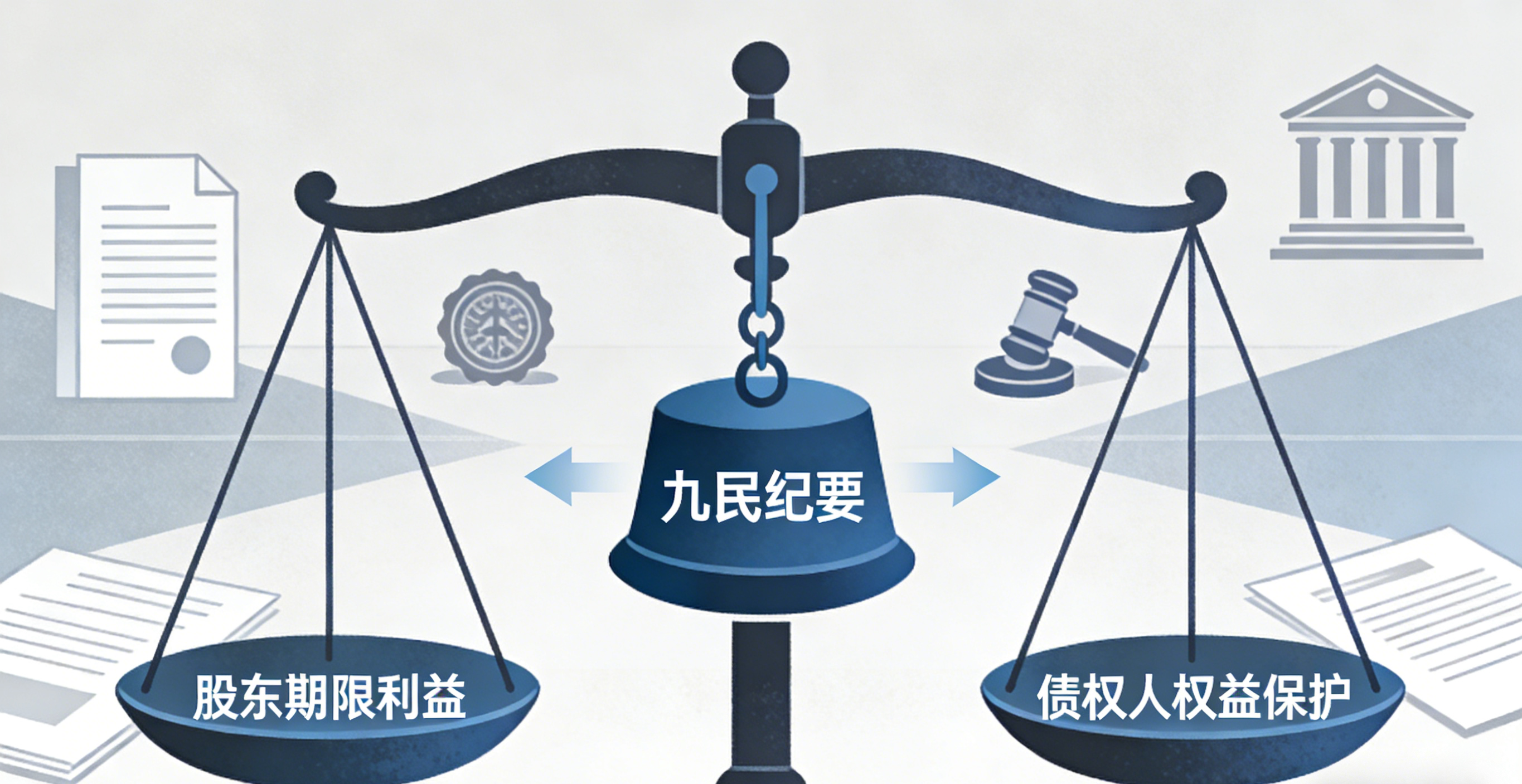
The promulgation of the Minutes of the National Conference on Civil and Commercial Trials of Courts ("Nine People's Minutes") breaks through the above two provisions. Regarding whether shareholders' capital contributions should be accelerated, after affirming the general principle of shareholders' term interests, two exceptions have been established, one of which is:
In the case of the company as the person subject to enforcement, the people's court exhausted the enforcement measures and had no property to enforce, and there were reasons for bankruptcy, but did not apply for bankruptcy.
The Supreme People's Court's Provisions on Several Issues Concerning the Application of the Enterprise Bankruptcy Law of the People's Republic of China (hereinafter referred to as the "Bankruptcy Law Interpretation I") hold that when the debtor is unable to pay off the debts due and has obvious lack of solvency, it should be determined that it has the cause of bankruptcy. As for what is "obvious lack of solvency", according to Article 4, Paragraph 2 (3) of the Bankruptcy Law Interpretation I:
If the people's court is unable to pay off the debt due to compulsory enforcement, it may be determined that it obviously lacks solvency.
The above legal arguments are also basically consistent with the argumentation logic in the Beijing High People's Court (2020) Jing Min Zhong No. 10 Judgment.
3. Judicial practice
After the promulgation of the "Minutes of the Nine People", cases of courts across the country on adding shareholders who have not expired the capital contribution period as the person subject to enforcement have continued to emerge. According to the author's search for cases in Shanghai and Hunan, there are both those who support the addition, while others believe that shareholders' interests in the capital contribution period should be protected and do not agree to the addition.
(1) Support additional cases
In the Hunan Provincial High Court (2020) Xiang Min Shen No. 845 Civil Ruling, the court held that:
Although shareholders enjoy the benefits of time in accordance with the law under the registered capital subscription system, in cases where the company is the person subject to enforcement, the people's court exhausts the enforcement measures and has no property to enforce, has the reason for bankruptcy, and does not apply for bankruptcy. Therefore, the key to whether Zhong Qiwang can be added as the person subject to execution is whether Changxin Company has property available for enforcement. After investigation, Changxin Company had several civil disputes as the person subject to enforcement, and no property available for enforcement was found after the enforcement court inquired about its property information. Zhong Qiwang, as the original shareholder of Changxin Company, failed to pay the registered capital in full, and it was not improper for the court of first instance to add him as the person subject to execution in the enforcement.
In the "Enforcement Ruling" No. 21 of the Zhuzhou Hetang District Court (2022) Xiang 0202 Zhi Yi, the person subject to execution Zhuzhou Jixing Decoration Engineering Co., Ltd. ceased operations at the end of 2018, and the court held that:
In an enforcement case, the person subject to enforcement has no property available for enforcement, and the applicant requests the shareholder to accelerate the maturity of the shareholder's capital contribution, and requests the addition of the shareholder who has not paid the capital contribution in full as the person subject to enforcement, and the reason is established.
(2) Cases where additional cases are not agreed
In most cases where the addition was not agreed, the court rejected the application of the applicant for enforcement to add a shareholder as the person subject to execution on the grounds that the shareholder's capital contribution period had not expired.
For example, in the (2021) Hu 0104 Zhi Yi No. 187 ruling, the Shanghai Xuhui District Court held that:
Article 17 of the Provisions of the Supreme People's Court on Several Issues Concerning the Change and Addition of Parties in Civil Enforcement stipulates: "If the for-profit legal person as the person subject to enforcement has insufficient assets to pay off the debts determined by the effective legal documents, and the applicant for enforcement applies to change or add shareholders or contributors who have not paid or have not paid their capital contributions in full, or the promoter who is jointly and severally liable for the capital contribution in accordance with the provisions of the Company Law, the people's court shall support it." However, in this case, according to the articles of association of Jiantai Company, as of now, the capital contribution period of Yang Yajie and Chen Qixian has not expired, so Song Aiguo's application to add Yang Yajie and Chen Yixian as the defendants of the (2020) Hu 0104 Zhi No. 3802 execution case, this court does not support it.
Summary
After the implementation of the Nine People's Minutes, courts in various places have different understandings of whether shareholders who have not reached the capital contribution period can be added as the person subject to enforcement after the case is finalized, which leads to different enforcement results.
Putting aside the question of whether the addition of the person subject to enforcement will cause ordinary creditors who should have been paid proportionally in bankruptcy proceedings to receive priority in advance and be unfair to other bankruptcy creditors, we believe that under the current legal framework, combined with the cases handled by the author, it is possible to find a way to realize the additional shareholders who have not yet reached the capital contribution period for the person subject to enforcement, but this requires full communication with the enforcement judge and fully explain the business status, the final number of cases and other information that can prove the financial status of the person subject to enforcement.
-
- The Shareholder's Capital Contribution Period Interest After the Case Is Finalized
One of the distinctive features of China's Company Law is the implementation of the registered capital system, and at the same time the implementation of the subscribed registered capital system, under normal circumstances, shareholders enjoy the benefits of their subscribed capital contributions, and do not have the current capital contribution obligation for subscribed capital contributions that have not expired.202023-04 -
- Risks and Prevention Suggestions in the Company's Equity Transfer
Generally speaking, equity transactions are relatively important and complex, so it is necessary to enter into a written agreement to clarify the rights and obligations of both parties to the equity transaction in the agreement to achieve the purpose of reducing disputes. However, in actual transactions, there will be the following two forms of irregular equity transfer:202023-03