






I. Case Background: "Force Majeure" Dispute Arising from Delayed Delivery, Enterprise Faces Capital Chain Crisis
A small and medium-sized textile fabric export enterprise (hereinafter referred to as "our client") has been deeply engaged in the EU market for many years, mainly engaged in the export of cotton, linen and chemical fiber fabrics, with an annual export volume of about 12 million US dollars. In May 2023, our client signed a textile sales contract with a total value of 450,000 US dollars with a German importer, agreeing to deliver the goods in three batches, with the payment method being payment against copy of bill of lading.
On the eve of the shipment of the third batch of goods, due to a sudden congestion at a domestic port, the shipping schedule was delayed by 15 days, resulting in the goods failing to arrive at the Port of Hamburg, Germany as scheduled. The client then unilaterally notified the termination of the contract on the grounds that "port congestion constitutes force majeure", refused to pay the total amount of 450,000 US dollars for the first two batches of goods that had arrived at the port, and at the same time demanded that our client compensate for the production suspension losses of its downstream factories.
Our client was under dual pressure: on the one hand, the 450,000 US dollars payment was refused, accounting for 60% of its three-month working capital, and the capital chain was on the verge of breaking; on the other hand, the German client was its third largest purchaser in the EU, and once the cooperation was lost, the market share would shrink seriously.
II. Law Firm's Intervention: Multi-dimensional Legal Research and Judgment to Break the "Force Majeure" Claim
Upon receiving the client's emergency request for help, the cross-border business team of our firm quickly activated the emergency response mechanism and completed the following work within 24 hours:
(I) "Physical Examination" of Contract Clauses, Locking in Two Core Defects
-
Vague Force Majeure Clause: The original contract only generally stipulated that "delay caused by force majeure shall be exempt from liability", without clearly listing specific circumstances (such as port congestion, shipping company strikes, etc.), nor specifying the notification time limit and proof requirements. -
Missing Dispute Resolution Clause: No governing law or arbitration institution was agreed upon, allowing the other party to invoke its national law for defense at will.
(II) Evidence Offense and Defense: Negating "Unforeseeability" with Facts
-
Collection of Meteorological and Operational Data: Obtained the meteorological records of the sea area where the port is located for the same period in the past three consecutive years, showing that congestion at the port due to frequent typhoons in autumn is normal and not "unforeseeable"; at the same time, obtained the congestion early warning report issued by the port operating company, proving that the shipping company had notified the possibility of congestion one week in advance before loading. -
Logistics Certification: Coordinated with the freight forwarder to issue a "Statement on Cargo Detention", stating that the goods arrived at the port 5 days before the agreed loading date and were detained due to the shipping company's deployment issues, not due to our delayed delivery. -
Citing Article 79 of CISG: Sent a lawyer's letter to the other party, clarifying the strict interpretation of "impediment" under Article 79 of the United Nations Convention on Contracts for the International Sale of Goods (CISG) - it must be beyond the control of the parties and unforeseeable at the time of conclusion of the contract. Congestion does not meet this requirement, and the other party has no right to terminate the contract.
III. Cross-border Negotiation: Reaching a "Phased Delivery + Price Concession" Plan After Five Rounds of Consultations
With the advantage of evidence in hand, we led the negotiation strategy and proposed a solution that balances the commercial interests of both parties:
Overview of Negotiation Process
| Round | Other Party's Claim | Our Response | Progress |
|---|---|---|---|
| 1 | Insisted on terminating the contract | Presented Article 79 of CISG and congestion data, pointing out that their claim was unfounded | The other party softened their attitude and agreed not to terminate the contract temporarily |
| 2 | Requested a 15% price reduction | Proposed a 3% price reduction and phased delivery | Stalemate |
| 3 | Requested a 10% price reduction | Presented the cargo detention certificate, emphasizing that we had made every effort | The other party accepted the discussion on the price reduction range |
| 4 | Accepted a 5% price reduction but requested payment within 60 days | Secured a 90-day payment grace period | Basically reached an agreement |
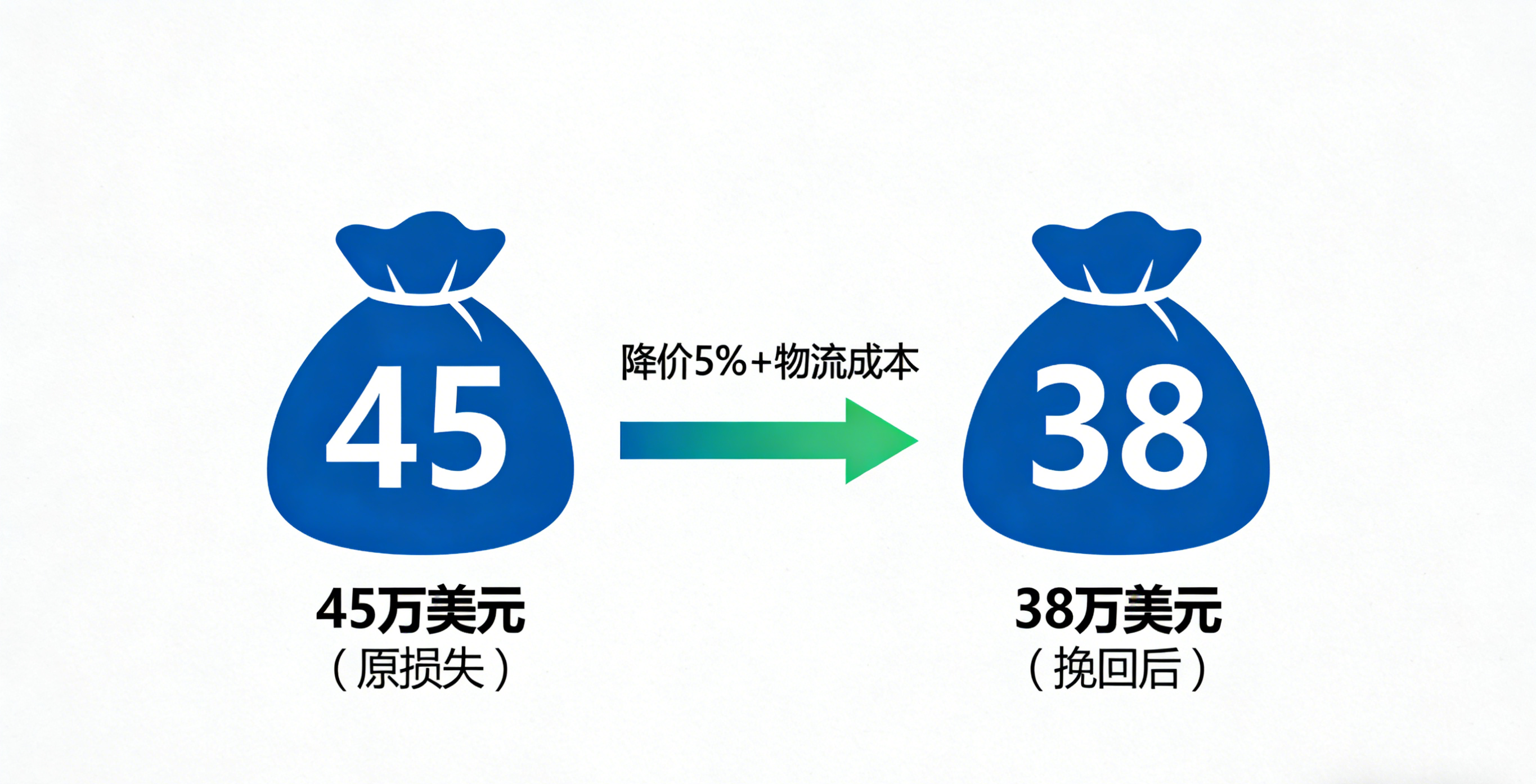
| 5 | Confirmed the final plan | Signed a supplementary agreement | Successfully recovered 380,000 US dollars (received 427,500 US dollars after a 5% price reduction, with a net recovery of 380,000 US dollars after deducting increased logistics costs) |
Core Plan
-
Phased Delivery: The remaining goods will be delivered in two batches with an interval of 15 days to ensure that the client's downstream factories do not run out of materials. -
5% Price Concession: As a gesture of commercial goodwill, to cover part of the other party's warehousing and labor costs. -
90-day Payment Grace Period: The client will make payment in three installments to ease our client's capital pressure.
IV. Compliance Upgrade: Building a "Firewall" Against Cross-border Contract Risks
After the dispute was resolved, our firm assisted the client in comprehensively upgrading the cross-border trade compliance system:
(I) Standardized Contract Template
-
Clear Scope of Force Majeure: Adopt a closed enumeration (war, natural disasters, government acts, etc.) + fallback clause, excluding commercial risks such as port congestion and shipping schedule delays. -
Dispute Resolution Clause: Agree to apply Chinese law, designate the Hong Kong International Arbitration Centre (HKIAC) as the arbitration institution, and specify Chinese as the arbitration language.
(II) Contract Performance Early Warning System
-
Real-time Monitoring of Logistics Nodes: Connect with the freight forwarder's system to automatically monitor 12 key nodes such as booking, port entry, loading, departure, etc., and automatically trigger an alarm if there is a delay of more than 3 days. -
Legal Risk Reminder Database: Update early warning rules according to the laws of the target country, such as compliance with the EU General Data Protection Regulation (GDPR), changes in anti-dumping tax rates, etc.
V. Achievements and Impacts
-
Direct Loss Recovery: The full amount of 450,000 US dollars payment was recovered, with a net recovery of 380,000 US dollars after deducting the price reduction and additional logistics costs. -
Steady Growth in Market Share: The client continued to cooperate with us, with order volume increasing by 25% year-on-year in 2024, and its EU market share rising from 7% to 9.5%. -
Zero Dispute Rate: After adopting the revised template for new contracts, there were no performance disputes for 12 consecutive months, and the contract performance early warning system successfully warned and resolved 3 potential delay risks.
-
- Cross-border Contract Restructuring Recovers Massive Losses for Foreign Trade Companies
small and medium-sized textile fabric export enterprise (hereinafter referred to as "our client") has been deeply engaged in the EU market for many years, mainly engaged in the export of cotton, linen and chemical fiber fabrics, with an annual export volume of about 12 million US dollars.182025-12 -
- Environmental Compliance Renovation Revitalizes Chemical Enterprises
A small and medium-sized fine chemical enterprise was ordered to suspend production for rectification by the environmental protection department due to excessive waste gas emissions, facing a daily fine of 20,000 yuan.292025-10