






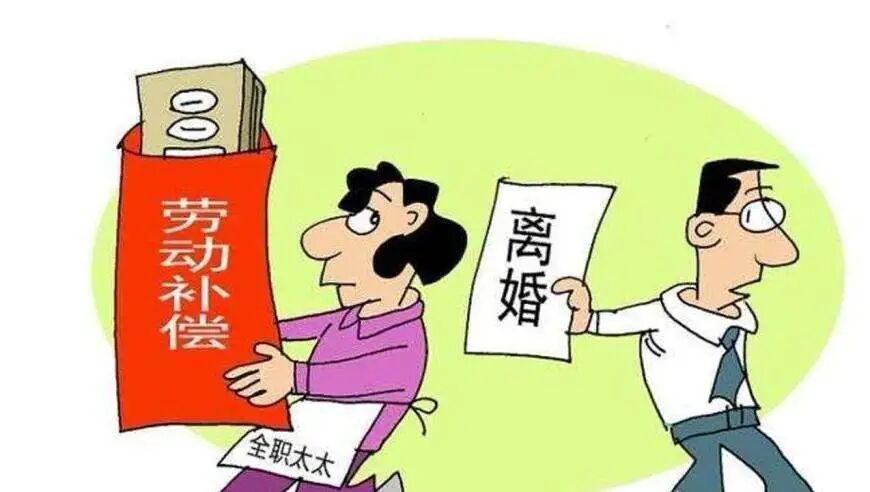
In December 2021, the famous male singer Wang Leehom was exposed to have officially divorced his wife Lee Jinglei after eight years of marriage. Later, Lee Jinglei released a long article accusing Wang Leehom of infidelity during the marriage, once again pushing the discussion on the topic of full-time housewives to a high point of public opinion. The life focus of "full-time housewives" mostly revolves around their husbands and children. When the family is harmonious, they may be relatively happy. But if the marriage breaks down, can the rights and interests of "full-time housewives" who are in a vulnerable position be effectively protected by law? Are they entitled to corresponding economic compensation?
According to the clear provisions of Article 1088 of the Civil Code:
If one spouse has borne more obligations such as raising children, caring for the elderly, and assisting the other spouse in work, he or she shall have the right to request compensation from the other spouse when divorcing, and the other spouse shall provide such compensation. The specific measures shall be agreed upon by both parties; if an agreement cannot be reached, it shall be decided by the people's court.
In addition, the second paragraph of Article 47 of the Law on the Protection of Women's Rights and Interests stipulates:
During the duration of the marriage, if a woman has borne more obligations such as raising children, caring for the elderly, and assisting her husband in work, she shall have the right to request compensation from her husband when divorcing.
It can be seen from the above provisions that both the Civil Code and the Law on the Protection of Women's Rights and Interests stipulate that full-time housewives have the right to claim economic compensation from their husbands when divorcing, provided that certain prerequisites are met. However, there are no detailed provisions on the specific exercise conditions, issues concerned in discretion, compensation standards and other contents. Therefore, this article intends to analyze the right to claim economic compensation of "full-time housewives" from the perspective of judicial practice.

I. Conditions for Exercising the Right to Claim Economic Compensation for Divorce
Through sorting out and analyzing different cases, in judicial practice, the establishment of the right to claim economic compensation for divorce needs to meet the following conditions:
1. Time of Claim
The time for a party to exercise this right must be during the divorce proceedings, and shall not be raised when no divorce is requested or after the marital relationship has ended.
2. Adherence to the Principle of No Trial Without Prosecution
In specific trials, the court shall not apply this clause on its own initiative, but the judge can make corresponding judicial decisions in accordance with relevant legal provisions only after the party puts forward the claim.
3. Subject of Application
The exercise of the right to economic compensation for divorce stipulated in Article 1088 of the Civil Code is only applicable to the party who has borne more obligations, regardless of whether either party is at fault for the breakdown of the marriage. Even if the party who has borne more obligations is at fault for the breakdown of the marriage, it does not affect the determination of the economic compensation.
II. Main Difficulties in Judicial Adjudication
1. Determination of the Amount of Economic Compensation
Housework is different from social labor in the market and is often difficult to directly measure by market value. In housework, one party not only devotes a lot of time and energy, but also invests a lot of emotions, and these intangible contributions cannot be measured by money.
Through the analysis and summary of a large number of cases, in divorce disputes, judges mainly consider the following factors when determining the amount of economic compensation:
| Consideration Factors | Explanation |
|---|---|
| Duration of Housework | The longer the time, the higher the compensation. Including the time when one became a full-time housewife, and the daily/weekly/monthly working hours |
| Energy Consumed in Housework | Work with more emotional input such as caring for the elderly and children will result in higher compensation; physical labor will result in relatively lower compensation |
| Magnitude of Contribution to the Family | For example, giving up work to take care of children and the elderly means a great contribution and higher compensation |
| Husband's Income and Local Living Standards | Considering the husband's economic burden, the husband shall not be reduced to living in difficulty after the compensation is paid |
2. Difficulty in Evidence Collection
Housework is often closed, and it is difficult for outsiders to know which party has made a greater contribution. Even if one party undertakes most of the housework, the party will not have the awareness to deliberately preserve evidence, and may also not know how to retain valid evidence.
III. Response Suggestions
1. Clear Agreement Between Both Parties
Since neither the Civil Code nor the Law on the Protection of Women's Rights and Interests has clear provisions on the calculation method of such economic compensation, both parties can make an agreement on this on the basis of mutual understanding and consideration. For example, it can be agreed that if a woman resigns from her job to become a "full-time housewife", she has essentially made a certain contribution to the common life of the family, and the husband shall pay a certain amount of property monthly to compensate for the loss of the woman leaving the workplace. The amount can be comprehensively determined with reference to the prices of nannies, hourly workers, confinement nurses in the market, as well as the husband's income and the woman's contribution.
2. Consciously Pay Attention to the Preservation of Evidence in Daily Life
A woman can record audio or video, or save screenshots of chat records; she can also take photos and videos when doing housework, or taking care of children or the elderly to prove her contribution to the family, such as:
-
Take videos of cooking -
Take photos of feeding children -
Take photos of cleaning the house
3. Continuously Pay Attention to the Development of the Original Industry
Economic compensation is essentially a form of economic compensation for women who leave the workplace and make certain contributions to the common life of the family. In the case of difficulty in daily evidence collection, the development of the original industry can be used as a reference for the woman's expected income, i.e., "loss".
-
- What have we all Experienced in 2025
Standing at the intersection of the conclusion of the 14th Five-Year Plan and the start of the 15th Five-Year Plan, 2025 outlines the future with the brush of the rule of law. The Fourth Plenary Session of the 20th Central Committee of the Communist Party of China set the tone for the next five years, the official implementation of the Private Economy Promotion Law has given private enterprises a "reassurance pill", and the Public Security Administration Punishment Law has undergone its first major revision in nearly 20 years.212026-01 -
- Interpretation of the Building Law of the People's Republic of China
Legal Provisions:Article 19: Construction projects shall be awarded through bidding in accordance with law, and direct contracting may be adopted for those not suitable for bidding.312025-03