






"I feel like the fruits of my labor have been stolen." In March this year, Liu Minzhi, who works in Hangzhou, Zhejiang, encountered a depressing incident. She applied for a human resources position in a company, and the employer said that the probationary period was 3 months, and she wanted to assist the company in building a human resources system from 0 to 1. When her full-time period was about to expire, the leader refused to apply for her regularization on the grounds that "startups do not need too complex a manpower system", and said that "the agreement states that the probationary period plan belongs to the company".
Coincidentally, on the 6th day of the trial in a photography studio, Mr. Li, a retoucher, suddenly received a notice: "The quality of the pictures you edited is not good, and you won't use it tomorrow." According to the "agreement", he can only officially join the company through a 7-day "unpaid trial period", which also means that all his previous hard work has been "wasted".
These are not isolated cases. In reality, many companies are using words that cannot be found in the legal dictionary to turn workers' sweat into "free lunches" under the guise of "innovative employment".
1. Unpaid trial posts: "gray areas" that cannot be found in the legal dictionary
Ms. Wen from Gansu applied for a children's programming teacher at an education and training institution. On the 3rd day of the trial and another trial on the 5th day, HR sent a message: "Your teaching experience is insufficient and you are not competent." Ms. Wen asked to settle her salary for the past few days, and the other party replied very simply: "You are just learning from the class, and you should not be paid in the first place." ”
This is a typical routine of unpaid trial posts: set a 3 to 10 day "trial period", find a reason to resign near the end, salary? Not a single point. Workers want to defend their rights, but they are often stuck in the first step - how can I prove that I am your person without signing a labor contract?
Here we have to make a basic logic clear: there is no concept of "probationary post" in law, only "probationary period". According to Article 7 of the Labor Contract Law, the employer establishes a labor relationship with the employee from the date of employment. Whether you call it "trial post" or "trainee", as long as you use the work, you have established a labor relationship and have to pay.
Once a worker has a work-related injury during the trial period, the enterprise has to bear more than just wages - work-related injury compensation and administrative penalties.
2. Do not sign a written labor contract during the probationary period, and sign it after becoming a regular employee
An HR friend once asked me: "Is it okay to agree verbally during the probationary period and then formally sign the contract after passing the test?" ”
My answer is just one sentence: you are laying mines for yourself.
Article 10 of the Labor Contract Law clearly states that a written labor contract shall be concluded to establish labor relations. if the contract is not signed for more than one month but less than a year from the date of employment, twice the salary shall be paid per month; If it has not been signed for one year, it is deemed that an indefinite term labor contract has been concluded.
Don't think about "waiting for the regularization", the probationary period itself is part of the term of the labor contract. It is also not possible to sign a "probationary contract" separately - the law clearly stipulates that if the labor contract only stipulates the probationary period, the probationary period is not established, and the period is the term of the labor contract.
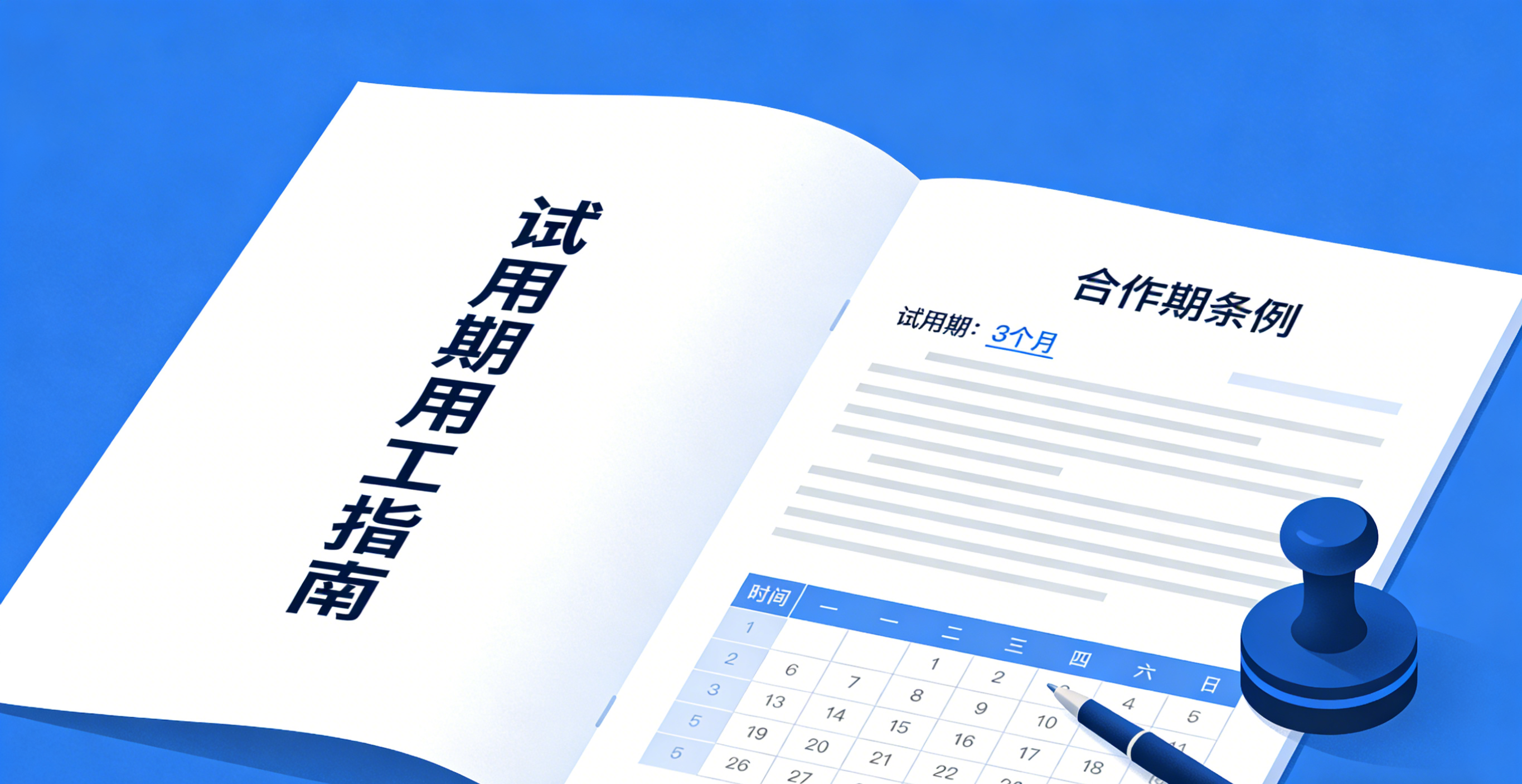
3. The duration of the probationary period is determined at will: the legal red line cannot be broken
Some employers have agreed on a long-term probationary period beyond the legal upper limit, or repeatedly agreed on a probationary period. In fact, the length of the probationary period is strictly linked to the term of the labor contract, and any attempt to break through the probationary period limit through "disguised extension" and "re-assessment" has no legal effect.
According to Article 19 of the Labor Contract Law, there is a clear statutory period for the probationary period:
-
If the labor contract period is more than three months but less than one year, the probationary period shall not exceed one month; -
if it is more than one year but less than three years, the probationary period shall not exceed two months; -
For labor contracts with a fixed term of more than three years and without a fixed term, the probationary period shall not exceed six months.
If the labor contract is limited to the completion of certain work tasks or the term of the labor contract is less than three months, the probationary period shall not be agreed.
The same employer and the same employee can only agree on a probationary period once. Once agreed, the probationary period shall not be extended at will, and the extension part shall be invalid, and the employee has the right to demand remuneration according to the regular salary. The probationary period is included in the term of the labor contract, and if the labor contract only stipulates the probationary period, the probationary period shall not be established, and the period shall be the term of the labor contract. If the illegally agreed probationary period has been fulfilled, compensation shall be paid to the employee according to the salary after the regularization and the period that has been performed beyond the statutory probationary period.
4. Salary discount during the probationary period: it is the norm to be lower than the legal standard
Some employers use the probationary period to pay wages lower than the minimum wage set by the local government. Many enterprises take advantage of this "80%" rule, and even blatantly break through the bottom line of "80%" to obtain labor at a lower level of salary than normal.
The Labor Contract Law stipulates that the wages of workers during the probationary period shall not be less than 80% of the minimum wages of the same position or not less than 80% of the wages agreed in the labor contract, and shall not be lower than the local minimum wage standard. This is the "double protection line" set by the law for workers.
5. Social security payment "naked": the probationary period has become a guarantee window period
Many companies believe that they can not pay social insurance during the probationary period, refuse to pay social security on the grounds that they have not become regular employees and are not regular employees, and even let employees sign the "Voluntary Waiver of Social Security Agreement", thinking that they do not need to be responsible if they sign it, which is an extremely dangerous cognition. Probationary employees also establish labor relations with the employer and enjoy various social insurance benefits in accordance with the law.
According to the law, the employer establishes a labor relationship with the employee from the date of employment, and there is no exception for the probationary period for social security payment, and the employee must register for social security within 30 days from the date of employment. Voluntary waiver of social security agreements is invalid because it violates the mandatory provisions of the law.
Failure to pay social insurance during the probationary period will not only harm the legitimate rights and interests of workers, but also face multiple risks such as administrative penalties, payment of economic compensation, and liability for compensation. If a worker suffers a work-related injury and the employer fails to participate in work-related injury insurance in accordance with the regulations, the employer shall pay the corresponding expenses in accordance with the work-related injury insurance benefits and standards stipulated by law.
6. Arbitrary dismissal of probationary employees: Lack of objective standards is a common problem
Many companies mistakenly believe that the labor contract can be terminated at will during the probationary period. In fact, a special right granted to employers by law compared with regular employees is that according to Article 39, Paragraph 1 of the Labor Contract Law, the employer does not need to pay economic compensation if it is proved that the employment conditions are not met during the probationary period. However, the employer bears the burden of proof.
The law stipulates that when an employer terminates a labor contract, it must prove:
-
The employment conditions have been clearly informed to the workers; -
There is evidence that the employee does not meet the employment conditions during the probationary period; -
Complete the assessment and notify the termination during the probationary period.
Article 44 of the Supreme People's Court's Interpretation on the Application of Law in the Trial of Labor Dispute Cases (I) stipulates: "The employer bears the burden of proof for labor disputes arising from decisions made by the employer on dismissal, removal, dismissal, termination of labor contracts, reduction of labor remuneration, calculation of the employee's working years, etc. ”
If the employer arbitrarily dismisses the probationary employee or fails to provide evidence to prove that the probationary employee does not meet the employment conditions, it is an illegal termination of the labor contract, and the company is required to compensate twice the economic compensation.

7. Failure to arrange rest and overtime pay in full during the probationary period
The probationary period requires employees to work overtime without pay, or overtime pay is calculated according to the minimum wage standard - I have seen this operation quite a lot.
It should be clear that probationary workers enjoy the same labor rights as regular employees. If overtime is arranged, 150% overtime on weekdays, 200% overtime on rest days, and 300% on statutory holidays.
It is gratifying that not all cases end in the loss of workers. Ms. Ren from Beijing joined a company as a customer service officer, and after 3 days of work, she found out that the company had set up a 5-day "unpaid trial period". She began to collect evidence such as screenshots of work content and recordings of tasks assigned by leaders. When she was fired on the last day of the trial, she presented evidence that she would get her salary back through labor arbitration, and the manager immediately changed her attitude, and finally Ms. Ren received a 600 yuan trial subsidy.
For employers, the probationary period is not a "waiver period", let alone a "free period". Treating the probationary period as an exploitation tool may save some costs in the short term, but arbitration, litigation, administrative penalties, and reputational damage are all enough to drink a pot. Standardizing employment and managing in accordance with the law is the long-term solution.
-
- Studying 627 Labor Dispute Cases, I Found the Three Most Dangerous Employment Methods for Enterprises
Many bosses think: Labor disputes occur by chance. But when I systematically studied 627 labor dispute cases (second-instance judgments), I found a very cruel fact:The vast majority of companies lose lawsuits not because the law is complicated, but because they have used some high-risk employment methods for a long time.162026-03 -
- Enterprise Probationary Compliance Employment Guidebook Manual
The probationary period is a key inspection period in the initial stage of labor relations, and its legal regulation not only gives enterprises the right to inspect the suitability of employees, but also sets strict boundary requirements.102026-02