






The popularization of digital office tools has moved management instructions from conference rooms and paper documents into WeChat groups and DingTalk dialog boxes. However, when the "@所有人" notice replaces the document stamped with a red seal, and when the "read" receipt is regarded as a sign of communication completion, business managers may not be fully aware that there are new legal risks lurking behind this convenience. A series of recent judicial decisions are clearly defining the boundaries of the use of digital tools, not the "extrajudicial ground" of management.
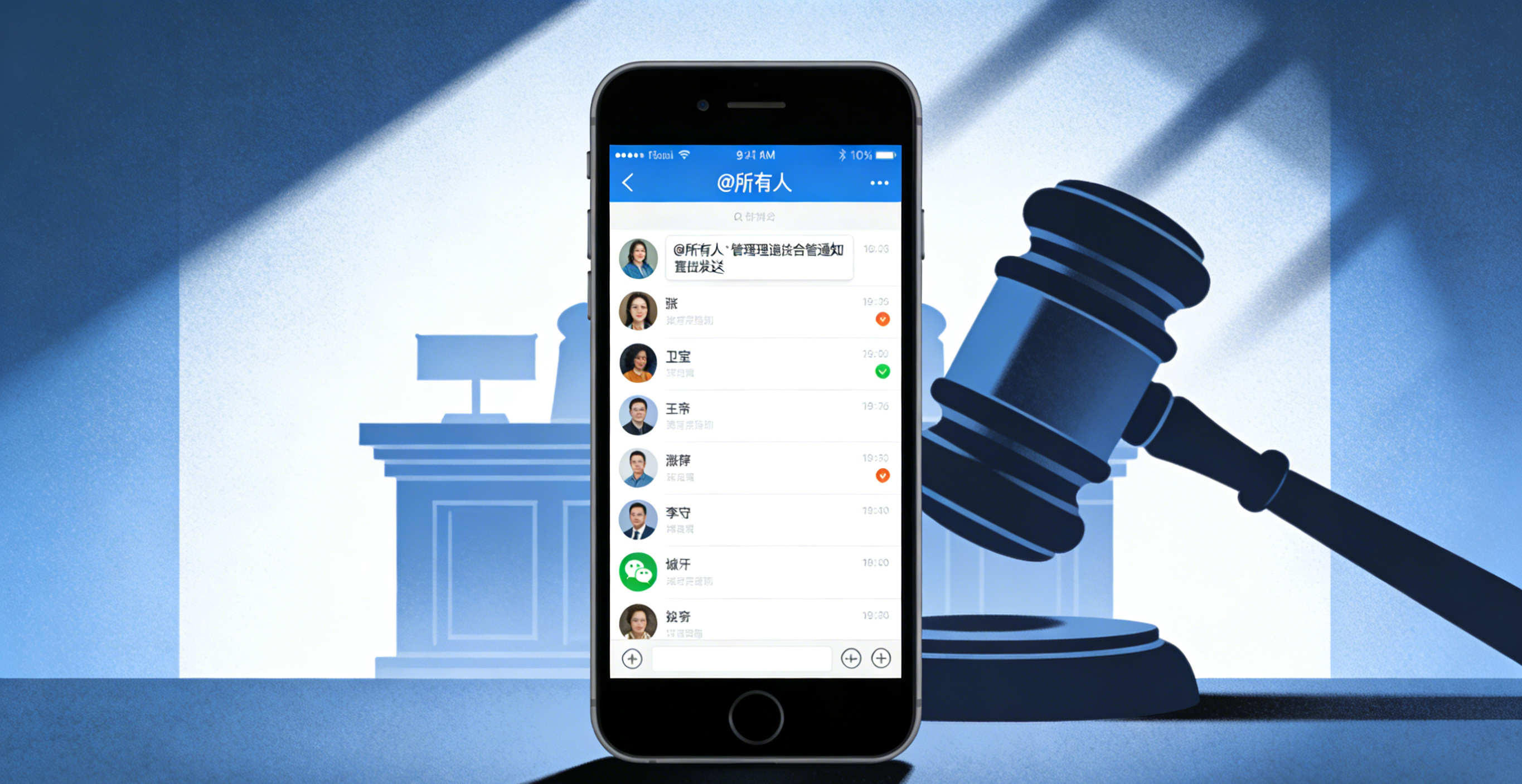
1. From "convenient tools" to "evidence to prove illegality"
In a labor dispute in Nantong City, Jiangsu Province, a company adopted a "special" management method because it could not negotiate with employees to transfer jobs: it established a separate DingTalk group for it, issued quantitative tasks that were almost impossible to complete every day, and continued to record the "unfinished" situation after it raised objections, and finally terminated the contract on this ground. After the trial, the court held that the company's move was "artificially created a situation of 'incompetence'", which was illegal termination and ordered to pay compensation.
Coincidentally, a company in Shantou, Guangdong Province directly issued a notice on the WeChat work group, claiming that an employee was "reduced in staff" and that his salary and social security would expire on the same day, and then he would be removed from the group chat. The company argued that this was only a "negotiation intention", but the court found that combined with follow-up actions such as suspension of wages, this constituted unilateral illegal termination of the labor contract.
These are not extreme cases. In reality, the practice of forcing employees to leave their jobs "voluntarily" by removing them from the work group, closing OA permissions, and taking back work accounts is called "hidden dismissal". The position of the judicial organs is becoming increasingly clear: the use of management tools cannot substantially deprive workers of their working conditions and legal rights. Once online behavior constitutes substantial damage to offline labor relations, enterprises need to bear legal responsibility.
2. Three major legal dilemmas of digital management
"Hidden dismissal" is an explicit risk, and in daily high-frequency use, enterprises also face deeper evidence and institutional dilemmas.
1. The "double-edged sword" nature of electronic evidence
For employees, DingTalk clock-in screenshots may successfully prove the time of employment and overtime. However, it is difficult for enterprises to use electronic evidence to prove the legality of their management. How does a notice issued by a WeChat account nicknamed "Qingfeng" prove that it was done by the company's managers? If the employee does not admit it, other evidence is required.
In addition, electronic data is easy to tamper with, and abnormal clock-in records unilaterally provided by enterprises without employee confirmation are likely not accepted by the court because the employee's sentence "the record may be modified by the background".
2. "Online abuse" of management rights
Digital tools amplify management efficiency and reduce the cost of mismanagement. The aforementioned case of "one person working group, three supervisors" is a process of alienating the transfer dispute into a process of continuous pressure and creating evidence of "incompetence" through digital tools.
At the same time, for frequent field positions, if a one-size-fits-all clock-in system is introduced, without considering the particularity of the position, it may be arbitrarily recognized as absenteeism due to a simple record of "not reporting when going out after clocking in".
3. Manage blurred boundaries
The "always-on" expectation brought about by work groups blurs the lines between work and rest. Managers assign tasks in the group at night, should these hours be counted as overtime? If the enterprise does not have a clear overtime approval system, it is likely to be found that actual labor has been provided in arbitration and overtime pay is required based on "read" or a short reply.

3. Build a digital management system with clear rights and responsibilities
The key to avoiding risks is to put legal thinking in front of them and incorporate digital tools into an institutionalized and standardized management framework.
1. Clarify the basic system of tool use
-
Regulations on the use of instant messaging tools have been issued to clarify the authority of their use in work communication, and specifically specify that important decisions such as salary changes, job adjustments, and contract termination must be supplemented by written official documents, and online notifications do not replace legal procedures -
The attendance system should be reasonable and legal, and the attendance process should be set up in line with the characteristics of the work for special positions -
Establish a clear and strict overtime approval system, and unapproved overtime work will not be regarded as overtime
2. Ensure the legitimacy of management behavior
-
When it comes to changing the core content of the labor contract, such as job transfer and salary adjustment, it is necessary to adhere to offline or formal means that can keep records, keep written agreements or key communication records, and cannot replace negotiation with unilateral group announcements -
Any termination must be based on statutory reasons, perform legal procedures, and issue a written termination notice -
It is strictly forbidden to isolate employees or force them to leave by moving out of the work group or closing permissions
3. Improve the credibility of electronic data
-
The labor contract stipulates that employees will use designated emails, WeChat accounts or DingTalk accounts to fix their identities -
For the announcement of important rules and regulations, employees are required to read online and confirm by clicking the confirmation button and replying to the designated email, and regularly ask employees to confirm the electronic attendance record and overtime status in writing -
For critical management communications, intentionally make archival backups -
In the event of a dispute, the organization should be able to provide a timestamped and full contextual link of information exported from the original carrier, rather than a simple screenshot
Epilogue
WeChat groups and DingTalk are indispensable efficiency tools for modern enterprises, but their legal attributes require managers to have a higher awareness of rules and procedures. True management wisdom does not lie in the use of technical means to create "convenience" for control, but in transforming technical tools into helping to build harmonious, stable and compliant labor relations through clear systems, fair procedures and good faith communication.
When enterprises learn to abide by the bottom line of the law and the temperature of management in the wave of digitalization, they can achieve stability and long-term development and avoid unnecessary legal disputes and reputational losses.
-
- Studying 627 Labor Dispute Cases, I Found the Three Most Dangerous Employment Methods for Enterprises
Many bosses think: Labor disputes occur by chance. But when I systematically studied 627 labor dispute cases (second-instance judgments), I found a very cruel fact:The vast majority of companies lose lawsuits not because the law is complicated, but because they have used some high-risk employment methods for a long time.162026-03 -
- Enterprise Probationary Compliance Employment Guidebook Manual
The probationary period is a key inspection period in the initial stage of labor relations, and its legal regulation not only gives enterprises the right to inspect the suitability of employees, but also sets strict boundary requirements.102026-02