






Zhang, the financial manager of a science and trade company in Beijing, returned to work after maternity leave, when the company suddenly unilaterally said that her position had been canceled and asked her to be transferred. After Zhang clearly refused, the company's operation was even more outrageous - she was directly removed from the work group, her work system permissions were closed, and salaries were stopped. During the trial, the company argued that this was just a normal management adjustment, but the Labor Arbitration Commission and the courts at both levels did not recognize it. The court found that the company's series of continuous behaviors was essentially an illegal termination of the labor contract during Zhang's lactation period. In the end, the company was sentenced to pay compensation, wage difference, overtime pay and maternity leave pay difference, etc., with a total amount of nearly 180,000 yuan!
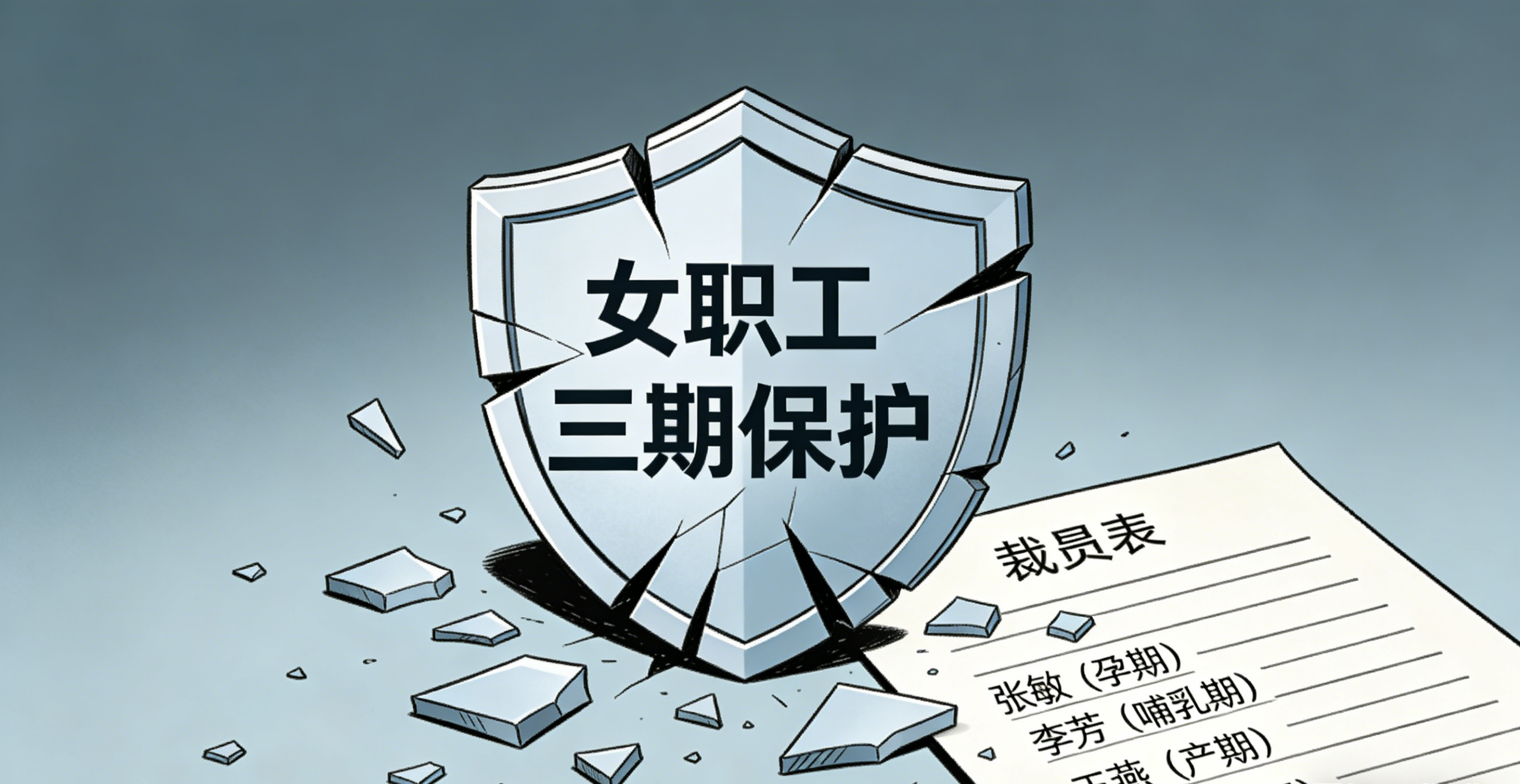
This case is a reminder to all enterprises: the law has already built an indestructible protective barrier for female employees during pregnancy, childbirth and lactation (referred to as the "third stage"). Whether enterprises use "business needs" and "organizational adjustment" as an excuse, or want to change the positions of female employees in disguise, reduce salaries, or even directly dismiss them, they will be strictly scrutinized by the judicial organs. Those seemingly "reasonable" management operations, as long as they touch the red line, are likely to lose everything.
1. The boundaries of the legal "umbrella": principles and exceptions
Many business owners will ask: Can pregnant female employees be fired? The answer is clear: in principle, no, with only one exception.
Article 42 of the Labor Contract Law clearly stipulates that female employees in the "third phase" are subject to special legal protection, and enterprises cannot unilaterally terminate the labor contract on the grounds that are not the fault of the employee, such as "the employee is not competent for the job", "there is a major change in the objective situation", and "economic layoffs". The original intention of the legislation is very simple, which is to ensure the occupational stability of women in special physiological stages, and to prevent female employees from facing the risk of unemployment because of pregnancy and childbirth, which is an unshakable basic principle.
Of course, this protection is not "bottomless", and the only situation that can dismiss a female employee in the "third phase" is that the employee himself has made serious faults, which is in line with the provisions of Article 39 of the Labor Contract Law - such as serious violations of company rules and regulations, serious dereliction of duty causing major damage to the company, or being investigated for criminal responsibility in accordance with the law. However, it should be noted that the bar for this exception is extremely high. If an enterprise wants to dismiss, it must produce solid evidence: it must not only prove that the employee is indeed at fault, but also prove that the fault has reached the level of "serious", and at the same time ensure that the system is legal and the procedure is proper. In practice, many enterprises lose arbitration lawsuits because of imperfect systems, insufficient evidence, or inability to prove that the fault is "serious".
2. Common management misunderstandings and "high-voltage lines" of enterprises
Many labor disputes are actually caused by enterprises themselves - the logic of managing ordinary employees is applied to the female employees of the "third phase", and in the end the gains outweigh the losses. These common misunderstandings and "high-voltage lines" must be avoided by enterprises:
-
The first high-frequency misunderstanding: because the performance of female employees declines after pregnancy, the dismissal process of "not being able to do the job" is initiated; Or when the company lays off employees, the "third phase" female employees are also included in the layoff list. These practices are directly in violation of the law, and once they do so, the company will undoubtedly lose.
-
The second fatal operation: just like the company in the previous case, it unilaterally transferred the position on the grounds of "job cancellation", feeling that it was exercising management autonomy; After the employee refused, he removed his work authority and stopped paying wages, feeling that this was a "reasonable response". However, in the court's view, this series of operations is coherent, and the essence is to force employees to resign, terminate labor relations, and properly terminate illegal terminations.
-
Core warning: The judicial authorities look at the "substantive impact", not the "superficial form". Even if the enterprise does not issue a written "notice of termination of the labor contract", as long as your behavior essentially deprives the employee of the basic conditions for providing labor - such as taking away work equipment, shutting down system authority, cutting off communication channels, and suspending wages, resulting in the inability to continue to perform the labor relationship, the court will find it as "factual termination", and the enterprise will also be held responsible. Especially for the "third phase" female employees, any unilateral operation that may affect their job stability and remuneration will be strictly reviewed by the court, and it cannot be sloppy at all.
-
There is also a more hidden pitfall: disguised pressure to force employees to resign. For example, transferring a pregnant female employee to a job or reducing her salary without justifiable reasons, deliberately increasing her work burden, or isolating and marginalizing her at work, making her unable to stay any longer, and taking the initiative to resign. Don't think that this kind of operation is "clever", in practice, this kind of behavior is easy to be recognized by the court, and will be characterized as "disguised illegal termination", and the company still has to pay compensation, lose the wife and lose the soldiers.
-

3. Build a compliant and warm management path
In the face of the "third phase" of female employees, the wisest choice for enterprises is not to test on the edge of "whether they can be dismissed", but to take the initiative to change their thinking, build a legal, reasonable and warm management process, and avoid risks from the root. Specifically, we can start from these points:
1. Improve the internal system and make the rules clear
Enterprises should formulate a clear and transparent management system, clarify the legal rights and company benefits of female employees in the "three phases" - such as the leave application process for pregnancy, maternity leave, and lactation, how to calculate wages, and if female employees need to adjust their work due to physical reasons, what are the principles of negotiation. Whether it is a job transfer, adjustment of working hours, or other arrangements, as long as it involves the rights and interests of female employees, it is necessary to negotiate with employees on an equal footing, not to unilaterally force decisions, and to keep written communication records, such as negotiation minutes and signature confirmation forms, to avoid follow-up disputes.
2. Respect physical differences and adjust positions flexibly
If a female employee is temporarily unable to adapt to her original job due to pregnancy or physical discomfort, the company should take the initiative to cooperate and give priority to adjusting the position through negotiation - such as transferring to a position with low work intensity and a safer environment, or providing flexible work and remote work convenience, so that she can take care of her work and body. It should be noted here that the salary after the transfer cannot be reduced in principle, and the legitimate rights and interests of female employees must be effectively protected, and salary reduction cannot be done in the name of secondment.
3. Negotiation and dissolution should be standardized and show sincerity
If both parties agree to terminate the labor contract after full communication, they must do a good job of standardizing the process and not be sloppy. The economic compensation plan given by the enterprise should be reasonable and sincere, and it is recommended to increase it moderately on the basis of the statutory compensation standard to reduce the possibility of subsequent disputes. At the same time, a written "Negotiation and Termination of Labor Contract Agreement" must be signed, which clearly states the rights and obligations of both parties, the amount of compensation, the time of payment, and the bottom clause that "there is no labor dispute between the two parties" to avoid employees regretting it afterwards and making claims again. In addition, enterprises can also provide some additional protection as appropriate, such as helping employees pay social security for a longer period of time, which is not only compliant, but also reflects the humanistic care of the enterprise.
4. Dismissal under special circumstances must strictly follow the procedures
If you really encounter a serious violation of discipline by a female employee in the "third phase" and have to start the dismissal procedure, you must keep in mind: procedural justice is more important than anything else. First, it is necessary to ensure that the rules and regulations based on them are legal and effective (through democratic procedures and publicity); secondly, it is necessary to investigate objectively and impartially, collect complete evidence to prove that the employee's fault has indeed reached the "serious" level; Finally, it is necessary to fulfill the obligation to inform in accordance with the law, listen to the employees' defenses, and make written records and keep good evidence throughout the process. Even if the evidence is sufficient and the dismissal can be done in accordance with the law, it is recommended to give priority to negotiating with the employee, reaching an agreement before termination, and giving reasonable compensation - this is the lowest legal risk and the best way to reflect the wisdom of enterprise management.
Epilogue
In fact, the management of female employees in the "third phase" tests not only the compliance awareness of the enterprise, but also the governance level and cultural temperature of the enterprise. The strict boundaries set by the law are not to "bind" enterprises, but to guide enterprises to standardize management and protect the basic rights and interests of female employees.
Those companies that are willing to jump out of the limitations of "short-term costs", respect the law, and treat employees well seem to have paid a little more energy and cost, but in fact they are making long-term investments - they can not only effectively avoid legal risks, not be dragged down by high compensation, but also win the trust and loyalty of employees, and build a cohesive team and a good employer brand.
For enterprises, only within the framework of the law, balancing the bottom line of compliance and humanistic care, and achieving a win-win situation between enterprises and employees, can they go more steadily and long-term.
-
- Studying 627 Labor Dispute Cases, I Found the Three Most Dangerous Employment Methods for Enterprises
Many bosses think: Labor disputes occur by chance. But when I systematically studied 627 labor dispute cases (second-instance judgments), I found a very cruel fact:The vast majority of companies lose lawsuits not because the law is complicated, but because they have used some high-risk employment methods for a long time.162026-03 -
- Enterprise Probationary Compliance Employment Guidebook Manual
The probationary period is a key inspection period in the initial stage of labor relations, and its legal regulation not only gives enterprises the right to inspect the suitability of employees, but also sets strict boundary requirements.102026-02