






In labor dispute cases, overtime pay claims are one of the most frequent types and can easily lead to group imitation - as long as one employee's claim is successful, multiple employees often follow up to defend their rights. This confuses many business managers: obviously the company has paid "overtime subsidies", or made it clear in the system that overtime pay is "lump-wrapped" calculation, but when it comes to arbitration litigation, it still repeatedly loses the lawsuit and has to pay a huge amount of overtime pay difference.
After combing through a large number of judicial precedents, it was found that the core problem of enterprise defeat lies in its own management - most of them accidentally stepped into several repeatedly verified "legal traps". Only by understanding these losing points can we help enterprises build a compliance defense line.
1. Evidence of failure to effectively manage the "overtime fact"
This is the main reason why enterprises lose overtime pay disputes. The legal principle of "whoever claims, who provides evidence" has been adjusted in overtime pay disputes: after the worker submits preliminary evidence such as screenshots of attendance and overtime notices, the burden of proof is transferred to the enterprise, and if the enterprise cannot refute it, it is deemed to have overtime facts.
In practice, enterprises often make three types of mistakes:
The overtime approval system is missing or useless, and employees can work overtime and record the hours by themselves Attendance records are unilaterally managed by the enterprise, without employee confirmation, and electronic data is easy to tamper with or not stored for a long time After the employee submitted evidence of non-working hours, the company only bluntly denied it as "unapproved", but could not deny the actual labor facts Real case
Liu, an employee of a water company, served as a security guard and cleaning post, and agreed on an overtime approval system, but the company acquiesced to the long-term acquiescence of not requesting approval. After Liu resigned, he submitted a claim for attendance records, and the company defended it with "unapproved", and the court found that the company recognized the fact of overtime with acquiescence, and ruled to pay more than 30,000 yuan in overtime pay.
2. Artificially narrowing the scope of "wages" defined by law
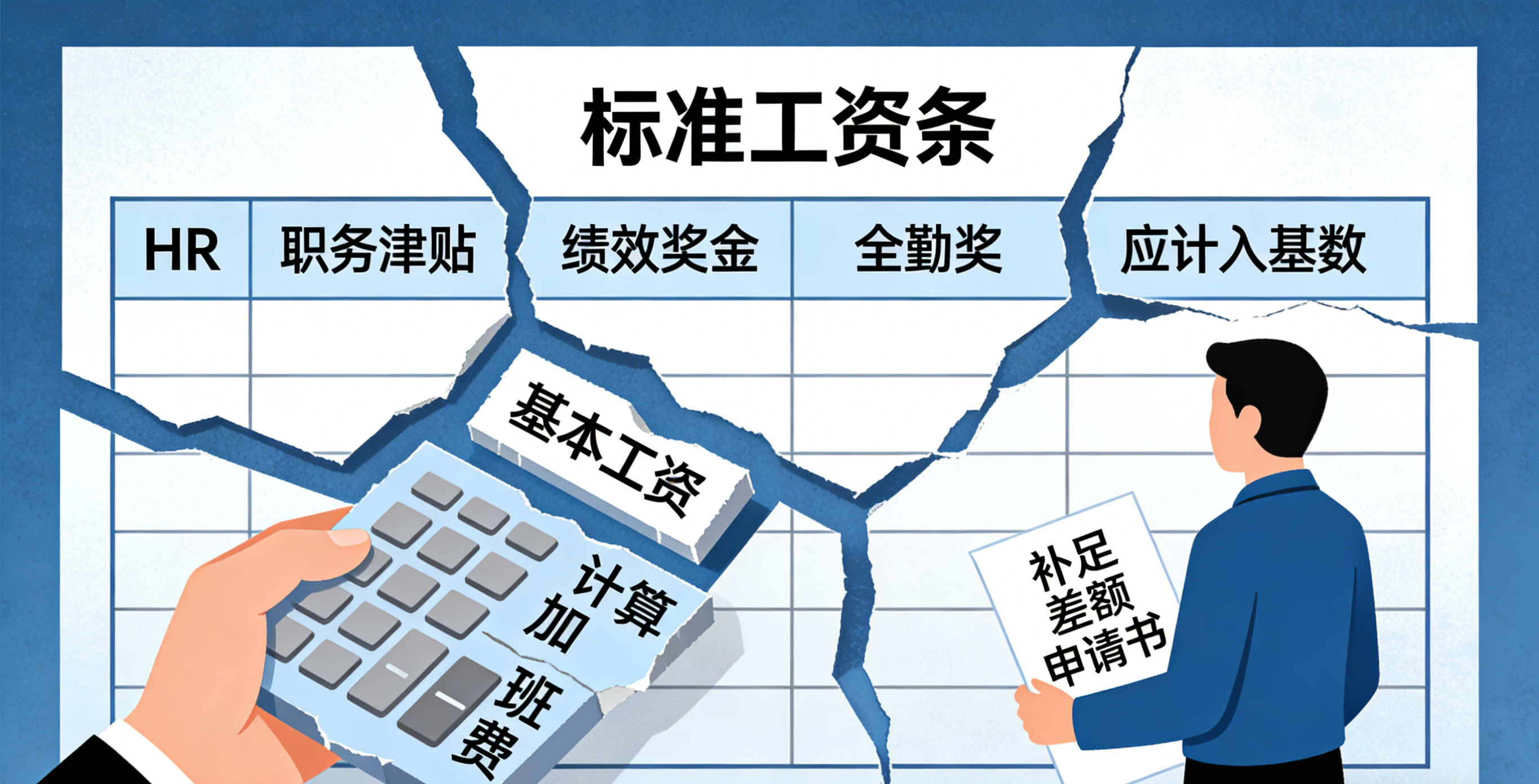
This is a pit that many companies step on - mistakenly thinking that overtime pay only needs to be calculated according to the "basic salary" on the labor contract, which is actually a fundamental misunderstanding of the law.
The law stipulates that the base for calculating overtime pay is the employee's "wages during normal working hours". Combined with local judicial practice, this usually refers to the full monetary remuneration due to normal labor provided by employees during statutory working hours, including not only hourly wages and piece-rate wages, but also fixed payments such as bonuses, allowances, subsidies, and income related to normal labor.
If the labor contract does not specify the amount of wages, the arbitral tribunal and the court generally directly use the actual average monthly salary of the employee in the 12 months before leaving the company as the calculation base, which often increases the difference that the enterprise needs to make up for a significant increase.
Real case
Xu joined an auto parts company, and the contract stipulated that overtime pay would be calculated based on basic salary. After Xu's resignation, the court found that the company's splitting of the salary structure was illegal, and the overtime pay base should include all monetary income during normal working hours, and ordered the payment of the difference of more than 58,000 yuan in overtime pay.
3. Misuse of "special working hour system" as a shield for exemption
Many business managers mistakenly believe that as long as they apply for the "irregular working hour system" or "comprehensive calculation of working hours system" for the relevant positions, they can not pay overtime pay. This idea is completely wrong.
Pre-approval: The special working hour system must be approved by the labor administration department before it can be applied. Without approval, the enterprise unilaterally declares that the implementation of the special working hour system is invalid, and overtime still needs to be calculated and paid according to the standard working hour system.
Irregular working hours are still required to pay 300% of the salary if they are arranged to work on statutory holidays For positions with a comprehensive calculation of working hours, overtime wages shall be paid at 150% for the part that exceeds the legal standard working hours during the cycle
4. Attempts to exclude statutory obligations with "lump sum" agreements
In order to control costs, many enterprises have signed agreements with employees to stipulate that "wages include all overtime pay" or implement "overtime pay package system". However, most of these agreements are found invalid in judicial review, and enterprises still need to make up the difference.
The core reason is that paying overtime pay is a legal obligation of enterprises, and the calculation standard is enforced by law and cannot be arbitrarily exempted or reduced by agreement between the two parties. If the amount of "contract" is significantly lower than the amount calculated in accordance with the law, the court will find the relevant provisions invalid and the enterprise must make up the difference.
Real case
Zhang joined a technology company and signed a "voluntary waiver of overtime pay" agreement. Half a year later, Zhang claimed resignation, and the arbitration commission held that the agreement exempted enterprise liability, excluded workers' rights, and was obviously unfair, and should be invalid, and ruled that the company should pay 24,000 yuan in overtime pay.

5. Practical suggestions for avoiding overtime pay disputes
Instead of passively responding to lawsuits, it is better to take precautions in advance and avoid risks from the source of management:
1. Establish a rigorous overtime management system
Strictly implement the overtime approval process, and unapproved overtime work will not be recognized as overtime in principle Establish a monthly or quarterly overtime confirmation mechanism and let employees sign to confirm their overtime hours 2. Clarify and standardize the calculation base of overtime pay
Clearly stipulate the base for calculating overtime pay in the labor contract to ensure compliance with local judicial regulations Avoid being calculated by the court based on the actual average salary due to unclear agreements 3. Carefully apply and apply special working hours
Suitable positions will be implemented after the application is approved in accordance with the law The comprehensive calculation of working hours should be monitored in the cycle Overtime on statutory holidays under the irregular working hours system still needs to pay 300% of wages 4. Keep the complete chain of evidence
Attendance records, overtime approval forms, salary slips, overtime pay vouchers, etc. should be kept for at least two years Ensure that records are tamper-proof and traceable
Epilogue
The root cause of enterprises repeatedly losing overtime pay disputes is not that they do not understand the law, but that the employment management is too extensive and the evidence awareness is weak. Workers' awareness of rights protection is increasing, judicial adjudication standards are becoming more and more unified, and enterprises can no longer treat overtime pay with "extensive management".
Only by integrating compliance requirements into every link of overtime management and building a complete closed loop can we truly grasp the initiative in employment management and resolve the risk of disputes from the source.
-
- Studying 627 Labor Dispute Cases, I Found the Three Most Dangerous Employment Methods for Enterprises
Many bosses think: Labor disputes occur by chance. But when I systematically studied 627 labor dispute cases (second-instance judgments), I found a very cruel fact:The vast majority of companies lose lawsuits not because the law is complicated, but because they have used some high-risk employment methods for a long time.162026-03 -
- Enterprise Probationary Compliance Employment Guidebook Manual
The probationary period is a key inspection period in the initial stage of labor relations, and its legal regulation not only gives enterprises the right to inspect the suitability of employees, but also sets strict boundary requirements.102026-02