






In the first two issues, we systematically sorted out the high-frequency legal minefield of enterprise dismissal of employees, and conducted an in-depth analysis of the details and key points in the case of "legal dismissal". Recently, we have received a large number of feedback from HR practitioners who hope to obtain a set of standardized operation guidelines with direct reference value.
To this end, this article will provide enterprises with a compliance operation manual covering the entire process of terminating labor relations. The content will focus on three core links: risk assessment before dismissal, scenario-based compliance implementation during dismissal, and closing archiving after dismissal, aiming to help enterprises systematically avoid employment risks.
1. Before dismissal: do a risk assessment first, don't speak first!
Before initiating the dismissal process, enterprises often neglect risk assessment due to eagerness to communicate with employees, resulting in a passive situation. The correct approach is to complete the following three-step systematic assessment before formal communication as the basis for subsequent decision-making.
Step 1: First clarify that the reason for your dismissal is not within the scope of the law
In the Labor Contract Law, there are only two categories of situations in which an employer can legally terminate a labor contract.
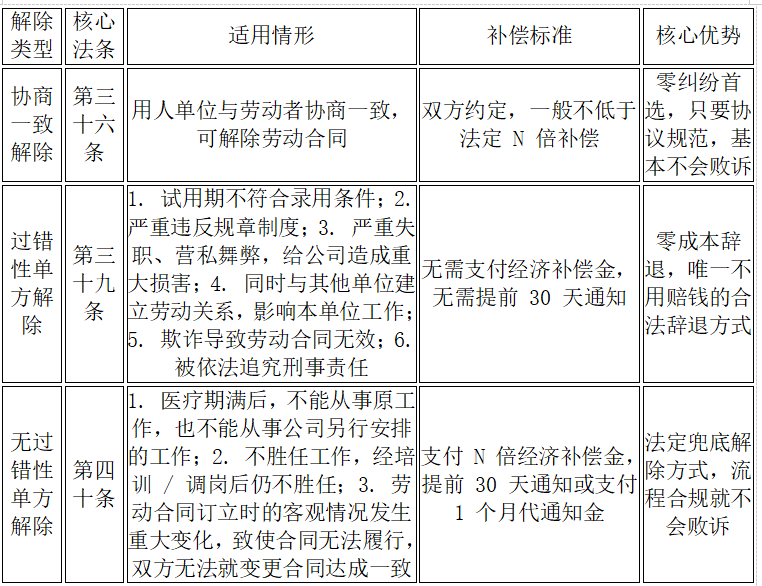
Step 2: Re-evaluate, do you have enough evidence? Incomplete process?
-
If "fault dismissal" is to be applied: it is necessary to review whether a complete closed loop of evidence has been formed? Has the rules and regulations on which it is based have fulfilled the procedures of democratic agreement and publicity? Does the determination of disciplinary violations have quantifiable standards? Have employees been given the opportunity to present and defend themselves? Has the trade union been notified in accordance with the law before the termination? -
If "no-fault discharge" is to be applied: it is necessary to review whether all legal procedures have been followed? Are there job competency standards confirmed by employees? After being initially determined to be incompetent, have you fulfilled your training or transfer obligations? Was the objective assessment conducted again after training or transfer? -
In the case of questionable evidence and incomplete procedures, the unilateral termination procedure should not be rushed, otherwise the risk of losing the case is extremely high.
Step 3: The optimal solution is always: priority consensus to lift!
Countless precedents tell us that 90% of zero-dispute dismissals are terminated by consensus. Even if you have complete evidence and compliant processes, unilateral dismissal is at risk of being arbitrated by employees, and if you terminate by consensus, as long as you sign a standardized agreement, it is equivalent to "insurance" for dismissal.
From the perspective of cost and benefit, the compensation paid for negotiated termination is actually a more economical and efficient risk control method than the 2N compensation faced by illegal termination, as well as the lawyer's fees, time costs and corporate goodwill losses incurred in dealing with arbitration and litigation.
2. During dismissal: Compliance operations in different scenarios cannot be missing
Scenario 1: Consensus termination (recommended preferred), 4-step zero-risk operation
1. Preparation stage: Settle accounts and prepare agreements
-
First calculate the statutory compensation standard: N = employee working years in the unit, pay 1 month's salary for every full year; if it is more than 6 months but less than 1 year, it will be calculated as 1 year; if it is less than 6 months, half a month's salary will be paid. Monthly salary is the average salary payable by employees in the 12 months before leaving the company. -
Determine the negotiated compensation plan, prepare the draft of the "Negotiated Termination of Labor Contract Agreement" in advance, and the core clauses must be complete and there must be no loopholes.
2. Communication stage: sincere attitude and traces throughout the process
-
choose a separate conference room and communicate one-on-one to avoid intensifying conflicts in public; -
When communicating, objectively explain the situation, do not belittle or threaten, clearly inform the compensation plan, and strive for the understanding of employees; -
The whole process of recording, before recording, it must be clearly informed that "in order to protect the rights and interests of both parties, we will record the whole process of this communication" to avoid being recognized as illegal recording and cannot be used as evidence.
3. Signing stage: Write the terms clearly and sign on the spot
-
After the two parties reach an agreement, the agreement is printed on the spot, signed and stamped by both parties, and it is strictly forbidden to require employees to sign a blank agreement. -
The "Negotiation Termination Agreement" must clearly write these 8 core clauses: (1) Both parties agree to terminate the labor contract on XX/XX/XX; (2) The company pays employees a one-time economic compensation of XX yuan, and the payment time and payment method are clear; (3) Employees should complete all work handovers before XX/XX and clarify the content of the handover; (4) Both parties confirm that all payments such as wages, overtime pay, untaken annual leave wages, social security, and provident fund have been settled without any disputes; (5) Employees promise to waive any rights to file arbitration, lawsuits, letters and visits with the company on matters related to labor relations; (6) Confidentiality obligations and non-compete agreements between the two parties (if any); (7) The agreement shall be made in duplicate, and both parties shall hold one copy and take effect after signing and sealing; (8) There are no other outstanding matters.
4. Performance stage: Execute as agreed, do not default
-
Strictly follow the time agreed in the agreement, pay compensation, settle wages, and do not default, otherwise employees have the right to directly apply for arbitration with the agreement and demand enforcement.
Scenario 2: Unilateral termination of fault (used as a last resort), 6-step compliance process
Taking the most common "dismissal for serious violations of discipline" as an example, these 6 steps must be completed, and one less step may be recognized as illegal:
-
Fixed and complete evidence: Collect all evidence of disciplinary violations, including clock-in records, disciplinary violation confirmation forms, chat records, recordings, monitoring, economic loss certificates, etc., to form a closed-loop evidence chain; -
Basis for verifying the system: Confirm that the disciplinary violations comply with the "serious violations of discipline" in the company's effective rules and regulations, and the system goes through democracy + publicity procedures, and the terms can be quantified and evidenced; -
Perform the defense procedure: Send the "Notice of Disciplinary Violations and Defense" to employees, inform them in writing of the facts of disciplinary violations and the corresponding system terms, give employees 3-5 working days to defend themselves, and keep the defense records; -
Notify the trade union: Before the termination, the trade union must notify the trade union in writing of the reason for the termination and the basis for the termination, and if the trade union has any objections, it must study and reply to the trade union in writing. -
Serve the notice of termination: Make a "notice of termination of labor contract", clearly state the facts, institutional basis, legal basis, date of termination, salary settlement, and work handover requirements, and deliver it to the employee in person for the employee to sign and confirm; If the employee refuses to sign for it, use EMS postal express mail to mail it to the correspondence address reserved in the employee's labor contract, mark the "notice of termination of labor contract" on the courier form, and keep the express delivery slip and logistics records; -
Synchronous processing: On the day of termination, the employee's salary will be settled simultaneously without the need to pay economic compensation.
Scenario 3: No-fault unilateral termination, 7-step compliance process
Taking the most common "dismissal from incompetent work" as an example, these 7 steps must be completed:
-
Prove the employee's incompetence: There are job competency standards confirmed by the employee, and there are objective assessment results to prove the employee's incompetence; -
Fulfill training or transfer obligations: Conduct targeted job training for employees, or reasonably transfer jobs, and keep training records, training sign-in forms, job transfer notices, and employee signature records. -
Re-assessment and evidence: After training/transfer, conduct objective assessment again to prove that the employee is still incompetent for the job; -
Investigate the prohibition of termination: confirm that the employee does not fall under the statutory circumstances that cannot be lifted during pregnancy, childbirth, lactation, medical treatment, work-related injury suspension and paid period, etc.; -
Notify the trade union: The same as above, the trade union must be notified in writing and listen to the opinions of the trade union; -
Delivery of termination notice: Send a written notice of termination to the employee 30 days in advance, or pay a notice in lieu of 1 month's salary, and clarify the basis for termination and compensation standards. -
Payment of economic compensation: A one-time payment of economic compensation to employees is based on N times the standard.

3. After dismissal: complete the finishing work, don't leave your tail
The delivery of the termination notice and the completion of payment do not mean the end of the labor relationship. Any oversight in the closing stage could lead to new controversy.
1. Issuance of the "Certificate of Termination of Labor Contract" (Certificate of Resignation) on the same day
-
On the day of termination of the labor contract, a resignation certificate must be issued to the employee, which is a legal obligation; -
The content of the resignation certificate must comply with the law, only write the term of the labor contract, the date of termination, the job position, and the number of years of work, and absolutely not write negative evaluations, such as "the employee was dismissed for violating discipline" and "poor work ability", otherwise the employee will be liable for compensation if it causes losses such as being unable to join the new company.
2. Complete the social security and file transfer procedures within 15 days
-
Within 15 days, go through the procedures for social security suspension and housing provident fund sealing/transfer for employees; -
If the employee has files stored in the company, the file transfer procedures shall be handled for the employee within 15 days, and the employee's file and social security must not be detained, otherwise the employee shall be fully compensated if the loss is caused.
3. Complete the handover of work and keep the handover record
-
Supervise employees to complete all work handovers, including company property, documents, project progress, customer information, etc., and after the handover is completed, both parties sign the "Work Handover Confirmation Form", making it clear that there is no objection to the handover; -
Note: Employees' wages and economic compensation cannot be withheld on the grounds that "the employee has not completed the work handover" unless the two parties clearly agree on the order of handover and payment in the agreement.
4. Archive the whole process of data and keep it for at least 2 years
-
All materials in the whole process of dismissal, including labor contracts, employee handbooks, rules and regulations, evidence of disciplinary violations, assessment records, termination notices, express delivery slips, negotiated termination agreements, work handover forms, audio and video recordings, etc., are all sorted out and archived. -
The statute of limitations for applying for arbitration in labor disputes is 1 year, and relevant materials should be retained for at least 2 years in case of emergencies.
4. Ultimate prevention: avoid dismissal disputes from the source
The best dismissal risk prevention and control is never "how to legally dismiss employees", but "how to standardize management and avoid reaching the step of dismissal". Do these 4 things well to reduce dismissal disputes by 90% from the source:
-
System first: Before joining the company, improve the "Employee Handbook", "Attendance Management System", "Performance Appraisal System" and "Reward and Punishment Management System", and complete the democracy + publicity procedure, so that every employee can sign and confirm receipt; -
Onboarding check: When joining the company, confirm the written employment conditions and job competency standards with the employee, write it into the labor contract or job description, and let the employee sign and confirm; -
Daily traces: attendance, assessment, and disciplinary violation handling, all written records should be made and asked by employees to sign and confirm. When employees violate discipline or fail to meet standards, deal with them in a timely manner, send written warnings and demerit penalties in a timely manner, so as to avoid difficulties in determining facts caused by accumulated accounts afterwards. -
Professional coverage: When dealing with complex or high-risk personnel such as senior managers, "phase three" female employees, work-related injured employees, and group layoffs, it is recommended to consult a professional labor lawyer before initiating the procedure. By paying relatively limited consulting costs, avoid high compensation and legal disputes caused by improper operation.
-
- Studying 627 Labor Dispute Cases, I Found the Three Most Dangerous Employment Methods for Enterprises
Many bosses think: Labor disputes occur by chance. But when I systematically studied 627 labor dispute cases (second-instance judgments), I found a very cruel fact:The vast majority of companies lose lawsuits not because the law is complicated, but because they have used some high-risk employment methods for a long time.162026-03 -
- Enterprise Probationary Compliance Employment Guidebook Manual
The probationary period is a key inspection period in the initial stage of labor relations, and its legal regulation not only gives enterprises the right to inspect the suitability of employees, but also sets strict boundary requirements.102026-02