






In the construction industry, contracts are the "backbone" of projects, and every word in the clauses affects profits and risks. However, for a certain construction enterprise, this "backbone" has become the most vulnerable link.
Seven Disputes in Half a Year, Profits Plunge to Rock Bottom
In the first half of 2025, the enterprise experienced an extremely difficult period. Due to imperfect contract terms, 7 disputes broke out consecutively in just six months, including delayed project payment, disputes over project quality, claims for construction period delays... Various problems came one after another. A rough statistics shows that the direct economic loss reached 3.5 million yuan, and the profit margin of multiple projects was compressed to below 8%, far lower than the industry average.
Enterprise managers found that many disputes could have been avoided by improving contract terms. But faced with piles of contract documents, they didn't know where to start - random clause design, vague division of rights and responsibilities, and lack of risk prediction had become the norm.
Systematic Sorting: 23 Types of Hidden Risks Behind Over 500 Contracts
After the Construction Engineering Team of our firm intervened, the first thing we did was: Go back to the source and conduct a comprehensive review.
We conducted a carpet-like sorting of more than 500 historical contracts signed by the enterprise in the past three years, compared the performance records and dispute focuses one by one, and finally classified the problems into three major categories and 23 specific risk points:
-
Vague Payment Nodes: Most contracts only stipulate "payment by progress", but fail to clarify how "progress" is determined. How much workload has the constructor completed? Who will confirm it? When to confirm it? These key issues have been pending for a long time. -
Unclear Quality Standards: Some contracts cite obsolete industry standards or only write "comply with national standards", leading to different opinions during acceptance. -
Unequal Liability for Breach of Contract: The liquidated damages clauses are seriously unbalanced, imposing excessive constraints on the constructor while having almost no restrictions on the employer. Once the other party breaches the contract, the cost of safeguarding our rights is extremely high.
These problems may seem trivial, but they constitute "invisible landmines" of enterprise risks.
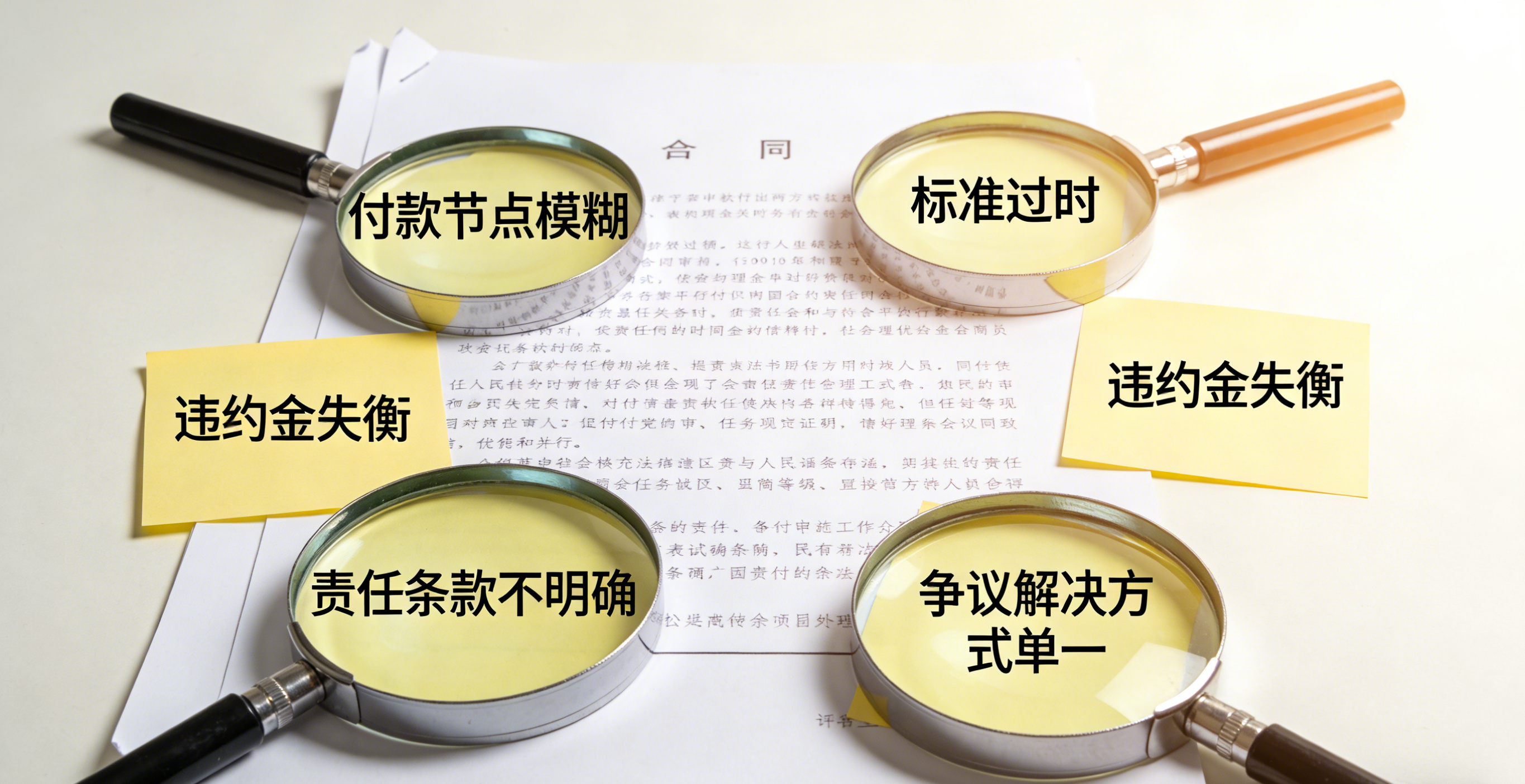
Customized Solution: 12 Clauses Redefine the Boundary of Rights and Responsibilities
On the basis of full research, we combined the "Judicial Interpretation of Construction Engineering Contract Disputes" and industry best practices to tailor a set of standardized contract templates for the enterprise. The focus is on reconstructing 12 key clauses:
-
Payment Nodes: Clarify phased payment according to "physical progress", and attach a detailed list of acceptance criteria to make "progress" visible and calculable. -
Handling of Quality Disputes: Stipulate that when a dispute arises, both parties jointly entrust a third-party appraisal institution to issue a report to avoid endless wrangling. -
Design of Liquidated Damages: Introduce a stepped liquidated damages mechanism, calculated in grades according to the degree and duration of breach, which not only protects the legitimate rights and interests of the enterprise, but also avoids being reduced by the court due to excessively high liquidated damages.
Mechanism Implementation: From "Human Management" to "System Management"
No matter how good the template is, it is only empty talk if it cannot be implemented. To this end, we assisted the enterprise in establishing a full-process management mechanism covering "contract drafting - review - performance - filing", and developed an online approval system.
-
Three-Review System for Check: Implement joint review by "legal affairs + engineering + finance" for large-value contracts. Legal affairs focus on clause compliance, engineering reviews technical parameters, and finance checks the matching degree between payment nodes and budgets. -
Node Reminder: The system automatically pushes reminders for key performance nodes to avoid new disputes caused by forgetting or delays.
Three months later, the results began to show.
Quantified Results: 80% Drop in Dispute Rate, Doubled Profit Margin
Data shows that three months after the operation of the mechanism:
-
**The incidence of contract disputes has decreased by 80%** , and the once frequent problems such as delayed project payment and quality disputes have been significantly reduced; -
**The recovery rate of project payment has increased from less than 60% to 90%** , and the cash flow has improved significantly; -
**The project profit margin has rebounded to 15%** , close to the excellent level of the industry.
More importantly, the enterprise has begun to establish a management philosophy of "prevention is better than remedy".
Long-term Empowerment: Make the Risk Manual a "Combat Guide" for Frontline Staff
To consolidate the experience, we also compiled the "Construction Engineering Contract Risk Manual", which details the design points and common traps of contract clauses combined with real cases. After the release of the manual, we organized 6 special training sessions covering key positions such as project managers, budgeters, and purchasers.
Today, the enterprise has established an internal contract database, which can quickly call adaptive templates according to different engineering scenarios, and the signing efficiency has increased by 50%. The construction enterprise that was once dragged down by disputes is moving towards a more stable development track.
-
- Cross-border Contract Restructuring Recovers Massive Losses for Foreign Trade Companies
small and medium-sized textile fabric export enterprise (hereinafter referred to as "our client") has been deeply engaged in the EU market for many years, mainly engaged in the export of cotton, linen and chemical fiber fabrics, with an annual export volume of about 12 million US dollars.182025-12 -
- Environmental Compliance Renovation Revitalizes Chemical Enterprises
A small and medium-sized fine chemical enterprise was ordered to suspend production for rectification by the environmental protection department due to excessive waste gas emissions, facing a daily fine of 20,000 yuan.292025-10