






I. Background of the Issue
Minimum Guaranteed Volume Clause is a common stipulation in PPP projects. However, when one or both parties breach the contract during project implementation, rendering the PPP contract unenforceable, the agreement on the minimum guaranteed volume clause often becomes a focal point of disputes between the two parties.
In recent years, the state has issued a series of policy documents to effectively curb the increase of implicit debts and prevent and resolve the risks of local governments' implicit debts. The Ministry of Finance also clearly stated in the Notice on Further Promoting the Public-Private Partnership in the Field of Public Services (Cai Jin [2016] No. 90) released in 2016:
"Prevent governments from assuming excessive expenditure responsibilities through fixed return commitments, repurchase arrangements, nominal equity and de facto debt, etc. Avoid replacing the medium and long-term expenditure responsibilities of PPP projects with current government purchase service expenditures, evading the relevant evaluation and demonstration procedures for PPP, and exacerbating the hidden risks of local government fiscal and debt risks."
Whether the setting of minimum guaranteed volume clauses in PPP projects involves government commitments of fixed returns has once sparked intense social discussions.
II. Concept of Minimum Guaranteed Volume Clause
The so-called minimum guaranteed volume clause originates from the project financing practice of "take or pay". In PPP projects, the minimum guaranteed volume clause is also known as the minimum usage volume. According to the explanation in the Guidelines for PPP Project Contracts (Trial) (Cai Jin [2014] No. 156) issued by the Ministry of Finance:
The government and the project company agree on a minimum usage volume for the project. When the actual usage volume of the project is lower than the minimum usage volume, the government shall pay according to the agreed minimum usage volume regardless of the actual usage volume.
The payment arrangement for the minimum usage volume can reduce the degree of actual demand risk borne by the project company to a certain extent and improve the financibility of the project.
III. Feasibility of Setting Minimum Guaranteed Volume Clause
The setting of the minimum guaranteed volume clause in PPP projects reflects the allocation of risks, and is an agreement on rights and obligations between equal subjects. It should be deemed valid based on the true intentions of both parties and on the premise of not violating the mandatory provisions of laws and regulations. At the same time, while setting the minimum guaranteed volume clause in the PPP contract, corresponding performance appraisal mechanisms and price adjustment mechanisms for social capital parties are generally agreed upon. Therefore, the setting of the minimum guaranteed volume clause does not mean that the government promises a fixed return.
The Ministry of Finance clearly stipulated in the Notice on Promoting the Application of the Public-Private Partnership Model (Cai Jin [2014] No. 76) released in 2014:
In accordance with the principle of "risks to be borne by the party most suitable to bear them", reasonably allocate project risks. Commercial risks such as project design, construction, finance, operation and maintenance shall be borne by social capital in principle, while policy, legal and minimum demand risks shall be borne by the government.
Although the expression on risk allocation in the later issued Implementation Opinions of the Ministry of Finance on Promoting the Standardized Development of Public-Private Partnership (Cai Jin [2019] No. 10) is:
Social capital is responsible for project investment, construction, operation and bears corresponding risks, while the government bears policy, legal and other risks.
The subject responsible for minimum demand risks is no longer clearly specified, and this change has triggered some discussions to a certain extent.
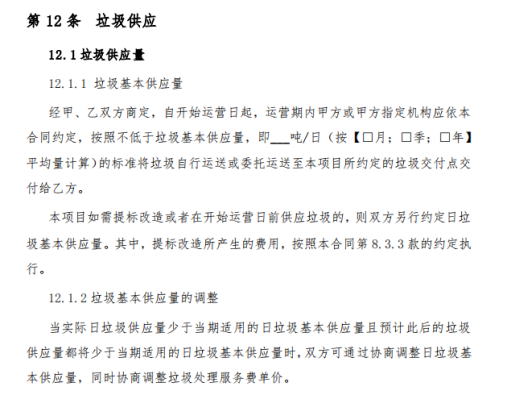
However, in Annex 6 (PPP Project Contract for Waste Treatment) of the Notice of the General Office of the Ministry of Finance on Issuing the Model Text of PPP Project Contracts in the Fields of Sewage Treatment and Waste Treatment (Cai Ban Jin [2020] No. 10) released by the Ministry of Finance in 2020, the basic supply volume clause is still clearly stipulated. It can be seen that it is feasible to agree on the minimum guaranteed volume clause in PPP projects.
IV. Suggestions for Setting Minimum Guaranteed Volume Clause
It is a common practice to agree on the minimum guaranteed volume clause in PPP projects, and the clause itself is different from the government's commitment of fixed returns. However, to avoid the risk of locking in and solidifying government expenditures that may be caused by the "minimum guaranteed volume", it is recommended that while agreeing on the minimum guaranteed volume clause:
-
Agree on an adjustment mechanism for the minimum guaranteed volume -
Agree on performance appraisal and price adjustment mechanisms
Through the above supporting mechanisms, ensure that the minimum guaranteed volume clause can not only provide necessary financing support for the project, but also avoid solidifying the government's expenditure responsibilities and prevent the risk of implicit debts.
-
- What Are the Matters Related to Contract Termination in the Civil Code
Contracts are ubiquitous in our lives. Whether it is corporate trade or the daily necessities, clothing, food, housing and transportation of natural persons, contracts need to be concluded everywhere. In recent years, due to the impact of the COVID-19 pandemic, the number of cases requesting contract rescission has increased significantly. This article intends to introduce the concept, types, procedures and other related issues of contract rescission.102023-02 -
- The Powers of the Legal Representative and the Main Risks They Face in the Process of Performing Their Duties
Clients often consult lawyers: "Our group company plans to establish a project company externally and has decided to appoint me as the legal representative of the company. Lawyer, could you tell me about the powers I will have as this legal representative and the risks I may face in performing my duties?" This article specifically analyzes these issues:202022-12